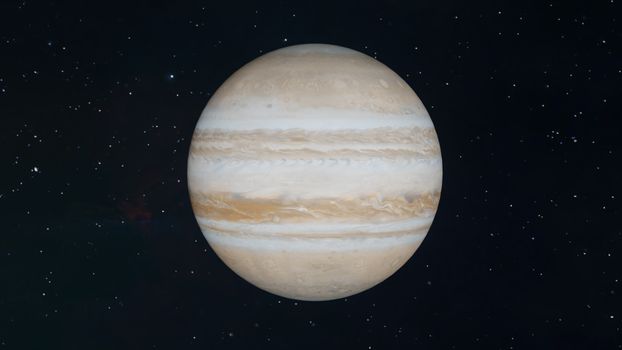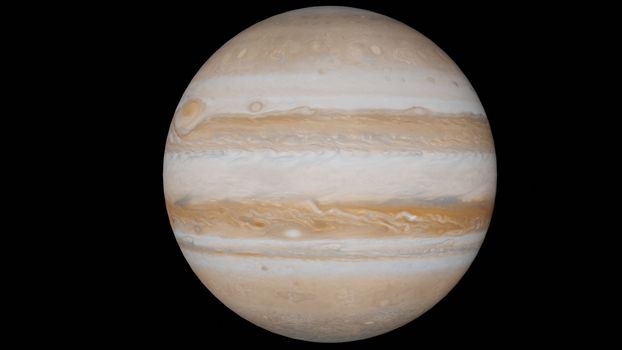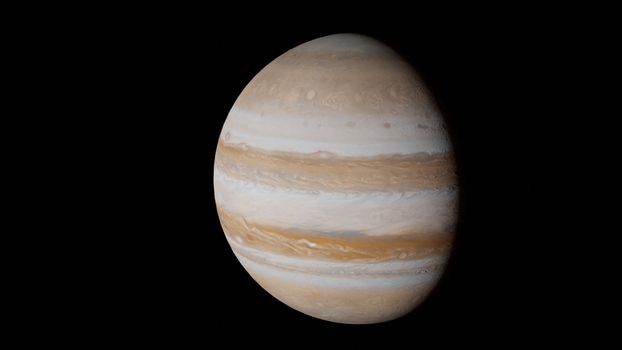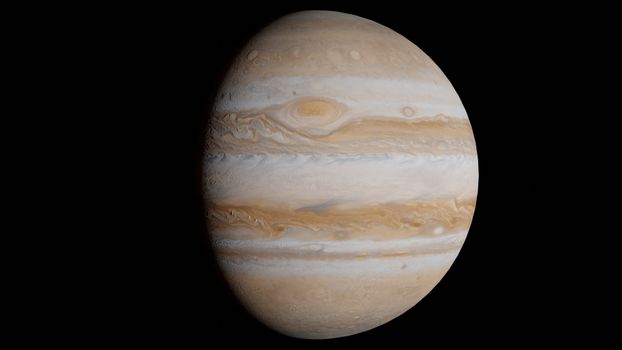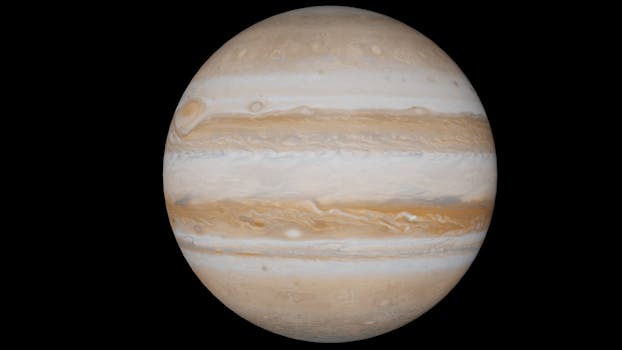
Far beyond the reach of any Earthly probe, shrouded beneath thousands of miles of dense clouds and raging storms, lies one of the solar system’s greatest enigmas: the core of Jupiter. As the largest planet in our neighborhood, Jupiter has long fascinated astronomers and planetary scientists. Yet, despite centuries of telescopic scrutiny and the recent revelations from NASA’s Juno mission, the nature of Jupiter’s core remains one of astronomy’s most compelling mysteries. How did this colossal planet form? What secrets are buried deep within its heart? Let’s journey into the depths of Jupiter to unlock the mysteries of its elusive core.
The Quest to Understand Jupiter’s Core
Ever since Jupiter was first observed through Galileo’s telescope in 1610, scientists have wondered what lies beneath its swirling clouds. Unlike Earth, Jupiter is a gas giant, composed mostly of hydrogen and helium. For decades, planetary formation models suggested that gas giants like Jupiter formed around a solid core of rock and ice, which gradually accreted gas from the primordial solar nebula. But directly observing Jupiter’s core is impossible: the planet’s immense gravity compresses its interior to extraordinary pressures and temperatures, making it opaque to instruments.
Until the last decade, most of what we knew about Jupiter’s core came from indirect observations and computer simulations. Then, in 2016, NASA’s Juno spacecraft began orbiting the planet, equipped with instruments designed to peer beneath the clouds using precise measurements of gravity and magnetic fields. Early results challenged our expectations and set the stage for a scientific revolution in planetary science.
.png)
What Lies Beneath: Composition and Structure of Jupiter’s Core
Jupiter’s core, if it exists as a distinct structure, is unlike anything found on Earth. Theoretical models predict that the pressure at Jupiter’s center is over 45 million times that of Earth’s atmosphere, and temperatures may reach 24,000 Kelvin—hotter than the surface of the sun. Under these conditions, the materials that make up Jupiter—mainly hydrogen—undergo extraordinary transformations.
Instead of existing as a traditional solid or liquid, hydrogen at such pressures becomes metallic, conducting electricity and generating the planet’s powerful magnetic field. This exotic “metallic hydrogen” forms a vast layer surrounding Jupiter’s core. Below that, scientists have long hypothesized a central core composed of heavier elements—rocks, ices, and metals.
But Juno’s gravity measurements have complicated this picture. Rather than a neatly defined core, data suggests Jupiter’s interior may contain a “diluted” or “fuzzy” core, where heavy elements are mixed with lighter hydrogen and helium over a large region, possibly extending up to half the planet’s radius. This challenges the classic “core accretion” model and raises questions about how Jupiter formed and evolved.
Comparing Jupiter’s Core to Other Planets
Understanding Jupiter’s core is crucial for comparative planetology. By studying how Jupiter’s interior differs from other planets, scientists hope to unravel the history of our solar system and the processes that shape planetary formation.
Below is a comparison table highlighting the estimated core characteristics of several solar system planets:
| Planet | Core Type | Estimated Core Mass (Earth Masses) | Core Composition | Core Temperature (K) |
|---|---|---|---|---|
| Jupiter | Diluted/Fuzzy | 10-25 | Rock, Ice, Metals (mixed with hydrogen) | ~24,000 |
| Saturn | Possibly Diluted | ~15 | Rock, Ice, Metals (mixed) | ~11,700 |
| Earth | Solid Inner, Liquid Outer | ~1 | Iron, Nickel | ~6,000 |
| Neptune | Solid/Icy | ~1.2 | Rock, Ice | ~7,000 |
| Uranus | Solid/Icy | ~0.9 | Rock, Ice | ~5,000 |
As the table shows, Jupiter’s core is vastly larger and more complex than the terrestrial planets, and even compared to Saturn, it stands out for its potential ‘fuzziness’ and size. Meanwhile, smaller ice giants like Neptune and Uranus have more traditional solid or icy cores.
How Scientists Probe Jupiter’s Hidden Heart
Since no spacecraft can survive Jupiter’s crushing interior, scientists have developed ingenious methods to study its core from afar. The most powerful tool in recent years has been the analysis of Jupiter’s gravity field. As Juno orbits Jupiter, slight variations in the planet’s gravity tug on the spacecraft, causing minute changes in its trajectory. By tracking these changes with exquisite precision—down to a fraction of a millimeter per second—scientists can infer how mass is distributed inside Jupiter.
Another key approach is the study of Jupiter’s magnetic field. Jupiter’s enormous magnetic field—by far the strongest of any planet—originates deep within the planet, likely in the metallic hydrogen layer surrounding the core. By measuring fluctuations and mapping the magnetic field’s structure, scientists gain clues about the depths where this dynamo action occurs.
Seismology, the study of how sound waves travel through a planet, has revolutionized our understanding of the Sun’s interior, but remains out of reach for Jupiter. However, researchers are exploring whether subtle oscillations on Jupiter’s surface, observed as rhythmic movements in the clouds, could provide hints about the core’s properties.
Jupiter’s Core and Planetary Formation Theories
The nature of Jupiter’s core is not just an isolated curiosity—it’s a keystone for theories about how planets form, both in our solar system and around other stars. The traditional “core accretion” model posits that giant planets begin as solid cores that gradually attract massive envelopes of gas. If Jupiter’s core is diluted and spread out, this could mean the planet experienced a violent past, such as a massive collision with another protoplanet, which disrupted and mixed its interior.
Alternatively, the “disk instability” model suggests gas giants could form directly from the collapse of gas in the early solar nebula, without requiring a solid core at all. Recent observations of exoplanets—giant planets orbiting other stars—show a wide diversity in size, composition, and internal structure, hinting that multiple pathways to planet formation may exist.
Jupiter’s fuzzy core, as revealed by Juno, has forced scientists to re-evaluate longstanding assumptions. Some models now suggest Jupiter’s core could have originally been more compact, only to become diluted by later impacts or by gradual mixing over billions of years. Such findings have profound implications, not just for Jupiter, but for our understanding of all giant planets.
The Future of Jupiter Core Exploration
While Juno’s mission has revolutionized our understanding, it has also raised new questions. Future missions, such as the planned ESA Jupiter Icy Moons Explorer (JUICE) and NASA’s Europa Clipper, will focus primarily on Jupiter’s moons, but their flybys will continue to provide valuable data about Jupiter’s gravity and magnetic fields. There are also proposals for next-generation missions that could deploy probes deep into Jupiter’s atmosphere, perhaps even sending instrumented “penetrators” to reach unprecedented depths.
On the ground, advances in laboratory physics are helping scientists simulate conditions inside Jupiter’s core. In 2020, researchers at the National Ignition Facility in California recreated metallic hydrogen in experiments reaching over 4 million atmospheres of pressure—conditions similar to those found inside Jupiter. These experiments help validate and refine models of Jupiter’s interior.
Astronomers are also searching for “Jupiter analogs” around other stars, using telescopes like the James Webb Space Telescope. By comparing Jupiter’s properties to those of exoplanets, scientists can test theories of core formation and evolution on a cosmic scale.
Final Reflections: Why Unlocking Jupiter’s Core Matters
Peering into Jupiter’s heart is more than just a quest to satisfy curiosity. The secrets locked inside this giant planet hold the keys to understanding not only how our solar system came to be, but how planetary systems form and evolve throughout the galaxy. Jupiter’s core, with its immense pressures, temperatures, and unique structure, represents a natural laboratory for physics, chemistry, and planetary science.
The more we learn about Jupiter’s core, the closer we come to answering profound questions: How common are giant planets like Jupiter? Could their presence be necessary for life to develop on Earth-like worlds? And what does Jupiter’s turbulent history tell us about the future of our own planet?
As new missions and technologies push the frontiers of exploration, the mysteries of Jupiter’s core beckon us ever deeper—reminding us that, in the vast cosmos, there are still wonders waiting to be discovered.