The Juno mission, spearheaded by NASA, has been instrumental in advancing our understanding of Jupiter, the largest and perhaps most enigmatic planet in our solar system. Launched on August 5, 2011, the spacecraft's journey was not just a route to the gas giant but a pathway to deeper cosmic discoveries.
Journey and Orbit of Juno Juno's journey to Jupiter involved a complex trajectory. After a five-year transit, which included a gravity assist maneuver from Earth to gain the necessary speed, Juno successfully entered into a polar orbit around Jupiter on July 4, 2016. This unique orbital choice allowed Juno to minimize exposure to Jupiter's intense radiation belts, while also providing a vantage point to observe both the poles and equatorial regions, areas less studied in previous missions.
Scientific Instruments and Objectives Equipped with a suite of nine instruments, Juno was designed to peer beneath Jupiter's thick clouds. The primary objectives include analyzing the composition of the atmosphere, mapping the magnetic and gravity fields, and examining the auroras. These observations aim to provide insights into Jupiter's structure and the processes occurring within the planet.
.png)
Revelations by Juno The data returned by Juno has been groundbreaking. Key findings include:
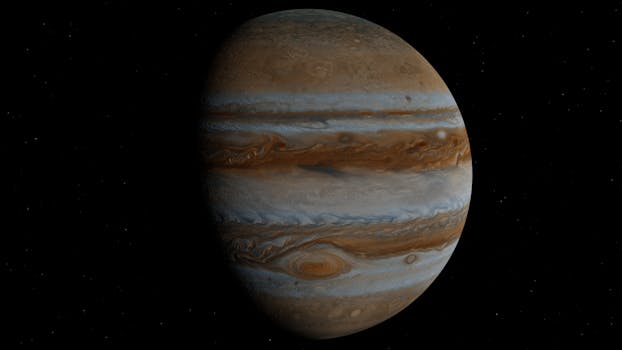
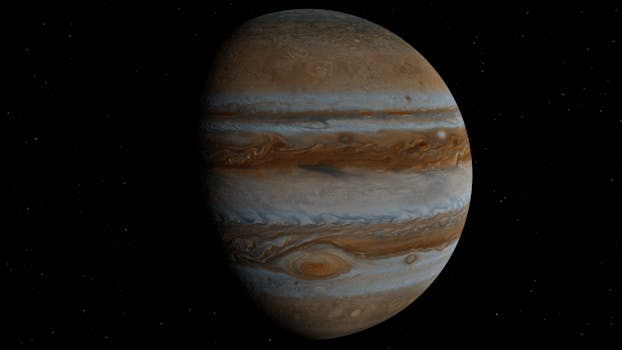
- Atmospheric Insights: Juno's Microwave Radiometer (MWR), which probes beneath the planet's visible cloud deck, has revealed fascinating details about the atmospheric dynamics and chemical composition. The data indicates that phenomena like the Great Red Spot, and other weather systems, extend deeper into the atmosphere than previously understood and show complex structures.
- Magnetic Field: Juno's measurements revealed that Jupiter's magnetic field is even more complex and irregular than expected. This has implications for understanding the dynamo process occurring in Jupiter’s interior, which is responsible for generating the magnetic field.
- Jupiter's Auroras: Juno has captured stunning images and data of Jupiter's auroras, the most powerful in the solar system. These observations are key to understanding the interaction between the magnetic field and the solar wind.
Challenges and Innovations Navigating around Jupiter is no small feat due to its powerful radiation, which can easily cripple spacecraft systems. Juno's orbit was meticulously designed to avoid the most intense radiation regions. The spacecraft's sensitive instruments are housed within a radiation-hardened vault to protect them from the environment.
Mission Extensions and Future Prospects Originally planned to conclude in July 2021, the mission has been extended to September 2025. This extension is crucial as it allows Juno to conduct further detailed studies of Jupiter's rings and its large moons, which could provide further clues about the solar system’s formation.
The Juno mission represents a significant leap in our understanding of Jupiter and the processes that govern giant planets. As Juno continues to orbit Jupiter and relay data back to Earth, it holds the promise of unraveling more mysteries of the gas giant. The insights gained from Juno will not only enhance our understanding of Jupiter itself but also of planetary systems beyond our own, continuing to illuminate the complexities of our solar system in the broader cosmic context.