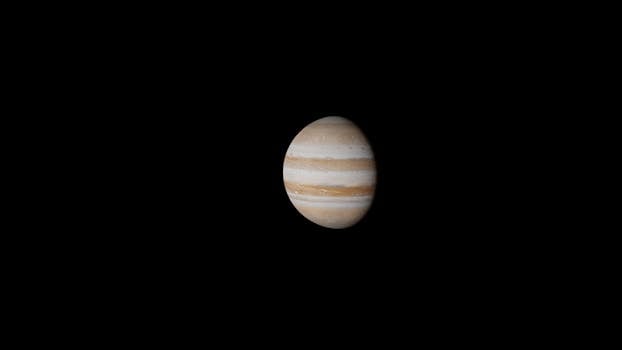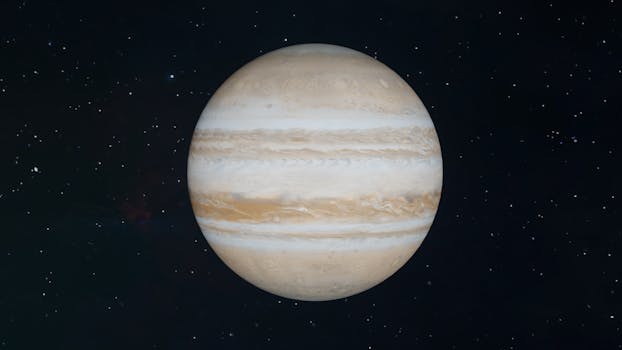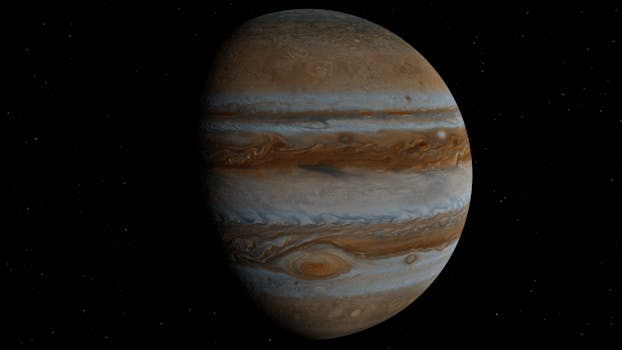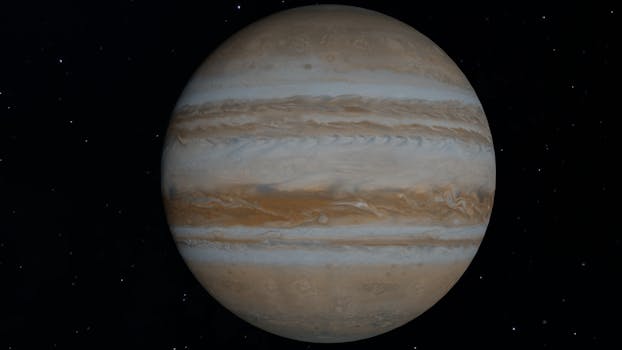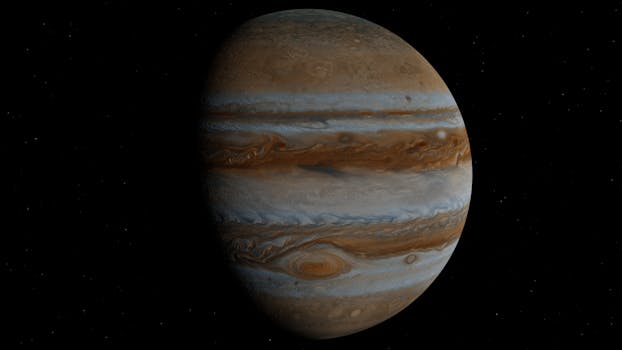
Jupiter, the behemoth of our solar system, has long captivated scientists and space enthusiasts with its immense storms, complex atmospheric dynamics, and enigmatic Great Red Spot. Through the deployment of sophisticated satellites and probes, we are gradually peeling back the layers of this giant planet, gaining unprecedented insights into its inner workings and its role in the broader cosmic context.
The journey to understand Jupiter has accelerated with missions like NASA's Juno spacecraft, which has been orbiting the gas giant since 2016. These exploratory endeavors are crucial for studying Jupiter's composition, weather systems, magnetic fields, and its entourage of moons, enriching our understanding of planetary science.
Atmospheric Secrets Unveiled
.png)
One of the key focal points of Jupiter exploration is its vast atmosphere, composed predominantly of hydrogen and helium, interspersed with traces of ammonia, methane, and water vapor. These elements form the backbone of Jupiter's meteorological systems, including its legendary storms. The Juno probe has been particularly valuable, offering detailed images and data that unveil the complex atmospheric phenomena. For instance, Juno's close flybys have provided stunning visuals and insights into the colossal polar cyclones and have probed the depths of the Great Red Spot, revealing that this storm extends well into the planet’s atmosphere.
Mysteries of Jupiter’s Magnetic Field
Jupiter's magnetic field, the strongest in the solar system, holds clues to the planet's internal dynamics. Data from Juno has shown that Jupiter’s magnetic field is even more complex than previously assumed, displaying unexpected irregularities that suggest a fluid or partially molten core. These discoveries challenge existing theories on magnetic field generation and could reshape our understanding of planetary formation.
Exploring the Galilean Moons
Jupiter is also renowned for its fascinating moons, particularly the Galilean moons: Io, Europa, Ganymede, and Callisto. Each moon presents unique characteristics and potential scientific treasures. Europa, with its icy surface hiding a potential subsurface ocean, is especially intriguing for astrobiologists. The forthcoming Europa Clipper mission aims to delve deeper into Europa’s ice, assessing its habitability and exploring its underground waters, which might harbor life.
Implications for Solar System Dynamics
Studying Jupiter also provides broader insights into the solar system. Jupiter’s immense gravitational force influences the orbits of other planetary bodies, playing a crucial role in the solar system’s structure and stability. Understanding Jupiter can thus help scientists decipher the formation and evolution of planetary systems and predict their future dynamics.
Challenges and Rewards of Jupiter Exploration
The path to exploring Jupiter is fraught with challenges, from its formidable radiation belts to its powerful magnetic field and dense atmosphere. Despite these obstacles, the scientific community remains driven by the potential knowledge to be gained. Each discovery about Jupiter not only enhances our understanding of the giant planet but also informs our studies of other gas giants in and beyond our solar system.
Conclusion: The Ongoing Quest to Unravel Jupiter’s Mysteries
The exploration of Jupiter through advanced technological means underscores our relentless quest for knowledge. Continued studies promise not only to unravel more about Jupiter’s hidden features but also to advance our overall quest in space exploration. The data and insights garnered from these missions are invaluable, propelling us closer to answering age-old questions about our universe and our place within it. With each mission, we make strides in understanding the complex tapestry of our solar system, setting the stage for future explorations that may one day take us beyond the familiar confines of our cosmic neighborhood.