The Impact of Jupiter's Gravity on the Solar System
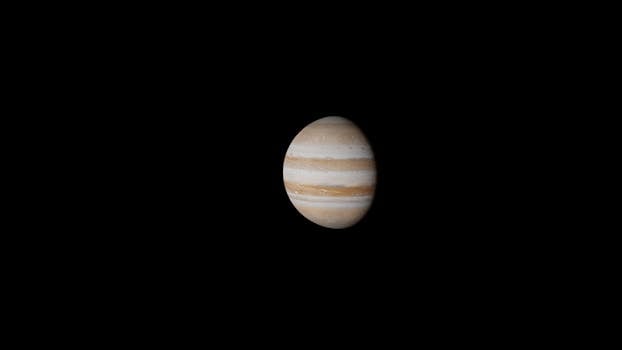
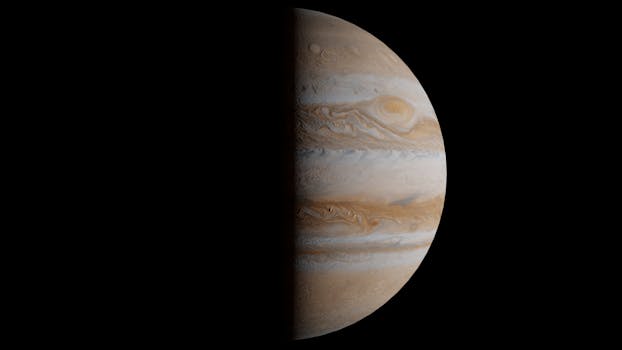
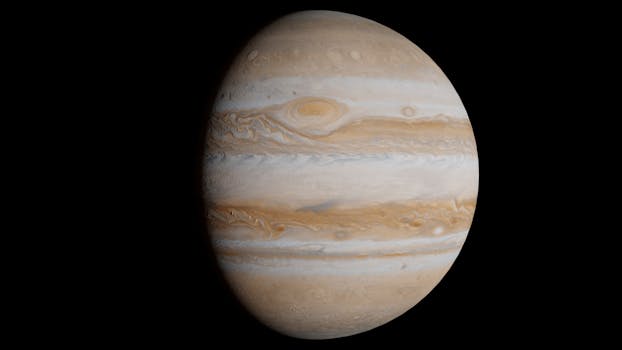
Jupiter, the giant of our solar system, is more than just a bright object in the night sky. Its immense mass—over 317 times that of Earth—makes it a gravitational powerhouse. This immense force doesn’t just keep Jupiter’s more than 90 moons in check; it also shapes the very architecture of the solar system, influencing the orbits of planets, steering comets, and even playing a potential role in the evolution of life on Earth. In this article, we’ll explore how Jupiter’s gravity acts as an invisible hand, sculpting the solar system in ways both subtle and dramatic.
The Sheer Scale of Jupiter’s Gravity
To understand Jupiter’s influence, it’s essential to grasp its sheer size and mass. With a diameter of about 142,984 kilometers, Jupiter is not only the largest planet in our solar system but also the most massive. Its gravitational pull is 2.5 times stronger than Earth’s, and it holds over 70% of the planetary mass in the solar system (excluding the Sun). This immense gravitational force extends far beyond its own orbit, impacting objects millions of kilometers away.
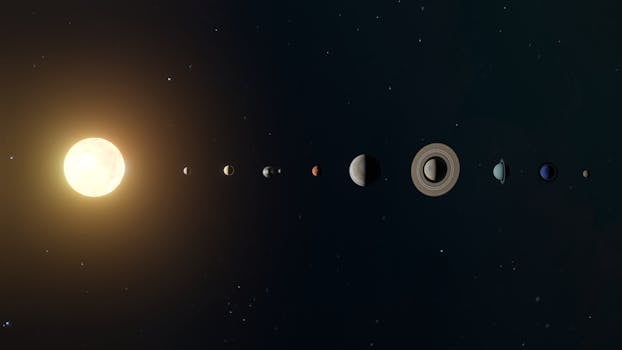
Jupiter’s gravity is strong enough to: - Dominate the motions of nearby asteroids and comets. - Affect the orbits of other planets, especially Mars and Saturn. - Shape the distribution of the asteroid belt and the Kuiper belt.These far-reaching effects make Jupiter a key player in the solar system’s structure and stability.
.png)
Jupiter as the Solar System’s Cosmic Shield
One of the most significant roles Jupiter plays is that of a cosmic shield. Its massive gravity acts as a vacuum cleaner, attracting and capturing or ejecting stray comets and asteroids that might otherwise pose a threat to the inner planets, including Earth.
- For example, in July 1994, fragments of Comet Shoemaker-Levy 9 collided with Jupiter instead of threatening the inner planets. The impact released an energy equivalent to 6 million megatons of TNT. - Studies suggest that Jupiter reduces the frequency of catastrophic collisions with Earth by a factor of two to three.This protective effect may have been crucial in allowing life to evolve on Earth. By reducing the number of devastating impacts, Jupiter may have helped create a more stable environment for life to develop.
Shaping the Asteroid Belt and the Kirkwood Gaps
Jupiter’s gravity doesn’t just protect the inner planets; it also sculpts the region between Mars and Jupiter known as the asteroid belt. The asteroid belt contains millions of rocky bodies, but it’s not a uniform field. Instead, there are gaps—known as Kirkwood gaps—that correspond to orbital resonances with Jupiter.
- Kirkwood gaps occur at specific distances from the Sun where an asteroid’s orbital period is a simple fraction (like 1:2 or 2:3) of Jupiter’s. - At these resonances, Jupiter’s gravity repeatedly tugs at the asteroids, gradually shifting their orbits and clearing out those regions.This gravitational influence helps prevent the asteroid belt from coalescing into a full-fledged planet and maintains the belt’s structure.
| Resonance Ratio | Distance from Sun (AU) | Kirkwood Gap? |
|---|---|---|
| 3:1 | 2.50 | Yes |
| 5:2 | 2.82 | Yes |
| 7:3 | 2.96 | Yes |
| 2:1 | 3.28 | Yes |
The table above shows some of the main Kirkwood gaps in the asteroid belt, each linked to a resonance with Jupiter’s orbit.
Jupiter’s Role in Redirecting Comets and Asteroids
Jupiter does more than just clear out dangerous objects; its gravity can also act as a slingshot, altering the paths of comets and asteroids that pass nearby. This process is known as gravitational assist or gravity slingshot.
- Long-period comets from the Oort Cloud, tens of thousands of AU away, can be deflected by Jupiter’s gravity, changing their orbits from potentially dangerous ones to harmless paths or even ejecting them from the solar system entirely. - Jupiter-family comets, which have short periods and orbits influenced by Jupiter, are an entire class of comets whose paths are dominated by Jupiter’s gravity. There are more than 400 known Jupiter-family comets.Without Jupiter’s intervention, Earth and the inner planets would experience far more frequent impacts from comets and asteroids.
Influence on Planetary Orbits and Solar System Stability
Jupiter’s gravity is also key to the long-term stability of the solar system. Its presence helps to maintain the relatively stable, nearly circular orbits of the planets, especially Mars, Saturn, and even Earth.
- Numerical simulations indicate that removing Jupiter would destabilize the orbits of the inner planets over timescales of millions of years, increasing the risk of planetary collisions or ejections from the solar system. - Jupiter’s gravitational influence is also responsible for the phenomenon of orbital resonance, which locks planetary orbits into stable patterns. For example, the 5:2 resonance between Jupiter and Saturn helps prevent their orbits from drifting into chaos.Jupiter’s stabilizing effect is so pronounced that some scientists consider its presence essential for the development of complex life on Earth, as it reduces the frequency of catastrophic disruptions.
Jupiter’s Moons: A Mini Solar System
Jupiter’s gravity doesn’t just influence things on a solar system scale; it also creates a rich and dynamic environment for its own moons. With over 90 known moons, Jupiter’s system is like a miniature solar system in itself.
- The four largest moons—Io, Europa, Ganymede, and Callisto—are known as the Galilean moons and were discovered by Galileo Galilei in 1610. - Ganymede is the largest moon in the solar system, even bigger than Mercury, with a diameter of 5,268 kilometers. - Tidal forces from Jupiter’s gravity create intense volcanic activity on Io and may create subsurface oceans on Europa and Ganymede.These moons are of great interest to scientists searching for extraterrestrial life, as Jupiter’s gravity helps create the conditions necessary for liquid water beneath their icy surfaces.
Jupiter’s Influence Beyond the Asteroid Belt
Jupiter’s gravitational reach extends even further, influencing the Kuiper Belt and the distant Oort Cloud.
- The Kuiper Belt, home to Pluto and many other icy bodies, is shaped in part by Jupiter’s gravitational interactions, which can scatter objects inward or outward. - It is estimated that Jupiter has ejected more than half of the original comets and icy bodies from the early solar system, helping to clear the region and stabilize planetary orbits.Jupiter’s gravity continues to play a role in shaping the solar system’s outer reaches, helping to maintain the delicate balance that allows planets and smaller bodies to coexist.
Conclusion: Jupiter—The Solar System’s Architect and Protector
Jupiter’s gravity is one of the most powerful forces in the solar system, shaping everything from the paths of tiny asteroids to the stability of planetary orbits. As a cosmic shield, it has likely played a vital role in protecting Earth and allowing life to evolve. By sculpting the asteroid belt, redirecting dangerous comets, and maintaining orbital stability, Jupiter acts as a guardian and an architect, ensuring the long-term stability and structure of our solar neighborhood. As we continue to study Jupiter and its effects, we deepen our understanding of not just our own planet’s history, but the dynamics that govern planetary systems throughout the universe.