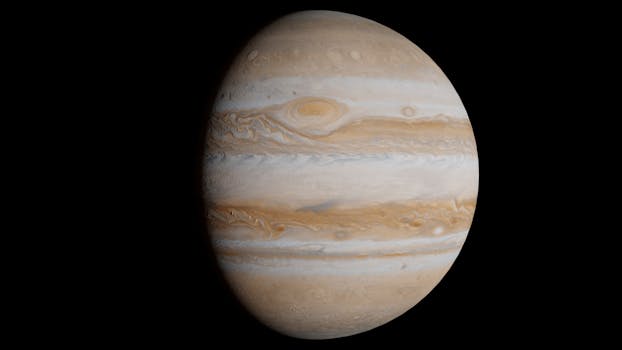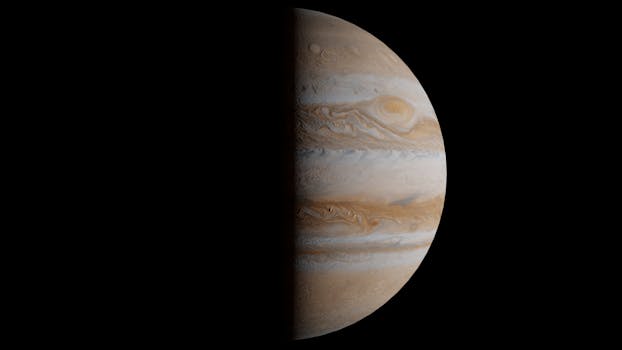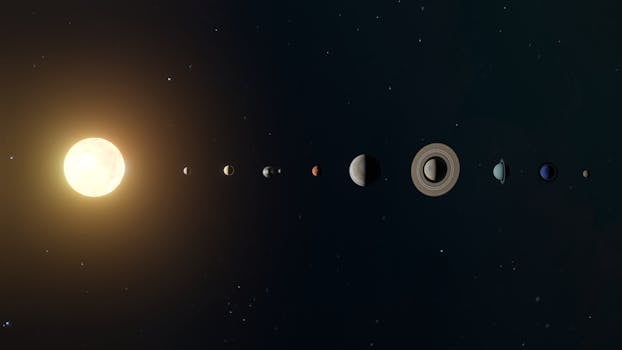
Jupiter, the largest planet in our solar system, has a profound gravitational influence on its moons, shaping their orbits, geology, and potential for hosting life. This gravitational force is a key factor in the complex dynamics observed in our solar system and offers valuable insights into celestial mechanics and planetary science.
Understanding Jupiter's Gravitational Impact
Due to its enormous mass, Jupiter's gravitational pull is extremely strong, affecting all 79 of its known moons. This influence is most apparent in the interactions with the Galilean moons: Io, Europa, Ganymede, and Callisto, which are among the largest and most studied.
.png)
Mechanisms of Gravitational Influence: Tidal Forces and Orbital Resonance
Jupiter’s tidal forces cause significant distortions in the moons' shapes and internal structures. This process, known as tidal heating, can lead to geological activity such as volcanoes and could potentially create subsurface oceans. For example, the intense geological activity on Io, including its many active volcanoes, is a direct result of tidal heating from Jupiter's gravity.
Furthermore, the orbital resonance among the Galilean moons—where Io, Europa, and Ganymede orbit in a synchronized pattern of 1:2:4—exacerbates these tidal stresses, increasing geological activity and heating. This resonance is a perfect demonstration of how gravitational forces can organize celestial bodies into remarkably stable and yet dynamic systems.
Implications for Moon Geology and Potential Habitability
The gravitational tug from Jupiter not only induces geological activity but also raises the possibility of life-supporting environments beneath the icy crusts of moons like Europa and Ganymede. The subsurface oceans hypothesized to exist under these moons could be warm enough to support life, thanks to the energy from tidal heating.
However, the same gravitational forces also present challenges. For instance, the severe volcanic activity on Io results from the same processes that might make Europa habitable. These extreme conditions present a dual aspect of Jupiter’s gravitational influence, showcasing both the potential for life and the inhospitable environments that can also be created.
Jupiter’s Role in Solar System Dynamics
The effects of Jupiter's gravity extend beyond its moons. Jupiter’s mass and position also help shield the inner planets from potential comet impacts, playing a protective role in the habitability of our own planet. The study of Jupiter and its moons thus not only helps us understand the conditions on other worlds but also provides insights into the dynamics that have helped life thrive on Earth.
Continued Exploration and Study
As we continue to explore Jupiter and its moons, particularly through missions like NASA's Juno spacecraft and the upcoming Europa Clipper mission, we will learn more about the intricate dance between gravitational forces and celestial bodies. These studies are crucial for advancing our understanding of not just our own solar system but also the characteristics of exoplanets and moons in other star systems.
In summary, Jupiter's influence over its moons presents a dynamic laboratory for studying the complex interplay of gravitational forces, geological activity, and potential habitability. These insights not only enhance our understanding of the universe but also underscore the interconnectedness of celestial phenomena across the vast expanses of space.