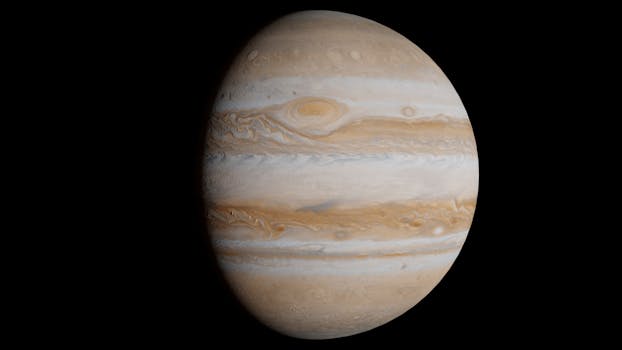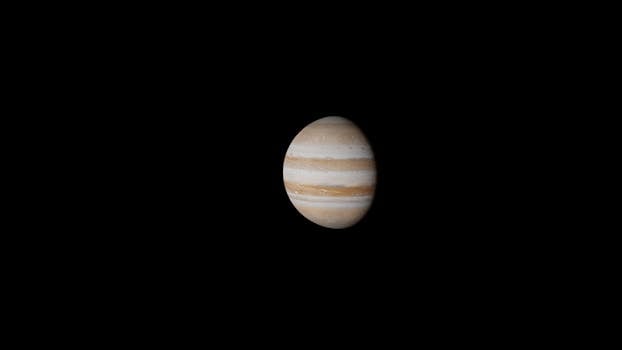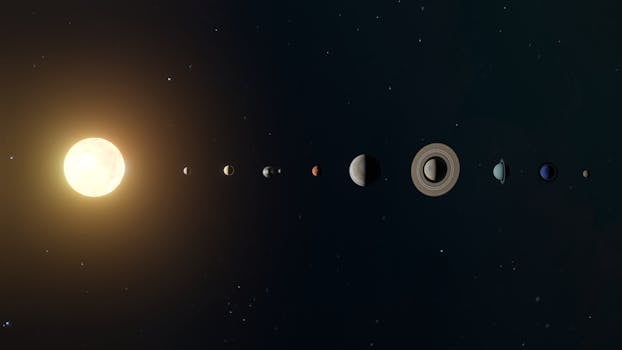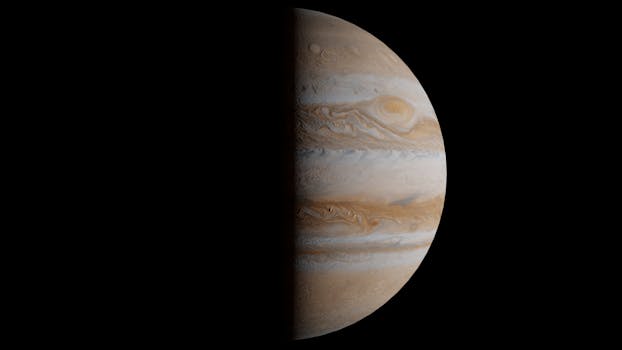
Jupiter, often referred to as the giant of our solar system, wields an immense gravitational force that critically influences the dynamics of our celestial neighborhood. With a mass roughly 318 times that of Earth, Jupiter's gravitational field not only affects the orbits of planets but also governs the movements of numerous asteroids and comets. This article explores the multifaceted impact of Jupiter’s gravity, shedding light on its scientific implications and its role in safeguarding Earth.
The Guardian of the Asteroid Belt
One of the most significant impacts of Jupiter's gravitational field is its interaction with the asteroid belt, a vast collection of rocky bodies orbiting between Mars and Jupiter. These remnants from the early solar system are kept in check by Jupiter’s gravity, which disrupts their potential to coalesce into a planet. The giant planet’s influence induces orbital resonances and collisions among these asteroids, preventing them from forming a larger planetary body and maintaining stability within the belt.
.png)
Earth’s Cosmic Shield
Jupiter’s role extends beyond just influencing celestial bodies' paths; it acts as Earth's protector. By deflecting or capturing comets and asteroids, Jupiter mitigates potential threats that could otherwise impact Earth. A vivid demonstration of this protective role occurred in 1994 when fragments of Comet Shoemaker-Levy 9 were drawn into Jupiter, showcasing what could have been catastrophic impacts had Earth been in their path. This event underscored Jupiter’s function as a cosmic vacuum cleaner, safeguarding other planets from significant impacts.
Facilitator of Space Exploration
Jupiter’s substantial gravitational pull is also a pivotal tool for space missions. NASA and other space agencies often leverage this force through gravity assist maneuvers, which help spacecraft gain necessary speed and adjust trajectories to reach distant destinations. This technique, crucial for missions like the Voyager probes, exemplifies how Jupiter’s gravity can be harnessed to explore further into our solar system and beyond.
Influencing Orbital Resonances
The gravitational effects of Jupiter are also evident in the orbital resonances observed among its moons and even in the orbits of other planets. The Galilean moons—Io, Europa, Ganymede, and Callisto—display a complex dance orchestrated by Jupiter’s gravitational tug. This not only offers a fascinating spectacle but also provides valuable insights into the moons’ internal structures and evolutionary histories, contributing to our broader understanding of celestial mechanics.
Broader Implications in Astronomy
Studying Jupiter’s gravitational influence aids astronomers in drawing parallels with other star systems, particularly in understanding exoplanets. Observations of how Jupiter interacts with its surroundings help scientists infer the dynamics in systems far beyond our own, offering clues about the potential habitability of exoplanets or their role in shaping their respective solar systems.
Conclusion
Jupiter’s gravitational field plays a crucial role in the architecture and safety of our solar system. From stabilizing the asteroid belt to protecting Earth from potential catastrophes and aiding in ambitious space missions, Jupiter’s influence is profound and far-reaching. As we continue to delve into the mysteries of space, the understanding of Jupiter’s gravitational might remains a key factor in uncovering the complexities of our universe.