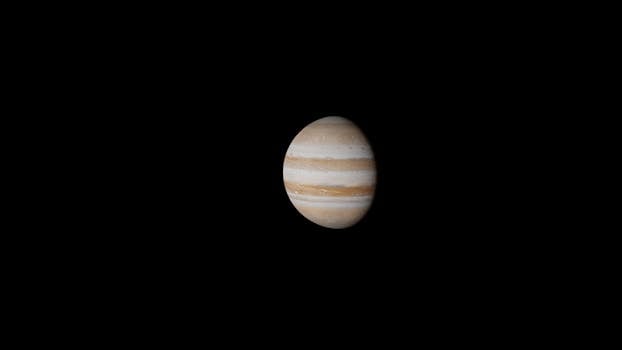
The exploration of Jupiter, the largest planet in our solar system, has long intrigued scientists. Known for its majestic storms and dense clouds, Jupiter presents a unique environment for studying extraterrestrial water, which is essential for understanding not only the planet itself but also broader cosmic phenomena, including the formation of the solar system and the potential for life on other planets.
Composition and Atmospheric Structure of Jupiter
Jupiter is primarily composed of hydrogen and helium, with no solid surface like that of Earth. Its atmosphere is a thick, deep layer rich in various gases, including ammonia, hydrogen sulfide, and notably, water vapor. The hypothesis that Jupiter's atmosphere might contain water dates back decades, driven by the understanding that water plays a crucial role in Earth's weather systems, atmospheric dynamics, and life-supporting processes.
.png)
Historical and Recent Missions to Jupiter
The quest for direct evidence of water in Jupiter's atmosphere has seen significant contributions from various space missions. NASA's Galileo probe, launched in 1989, was pivotal. In 1995, it deployed a smaller probe that descended into Jupiter's atmosphere, sending back data until it succumbed to the planet's extreme atmospheric pressure. Although it confirmed the presence of water, the data was limited to a small sampled region, leaving many questions unanswered.
Recent strides have been made by NASA's Juno spacecraft, which entered Jupiter's orbit in 2016. Equipped with the Microwave Radiometer (MWR), Juno has been able to delve deeper into the atmospheric layers, providing a more detailed analysis of water content. Juno's findings suggest that water constitutes about 0.25% of the molecules in Jupiter’s equatorial region, indicating a higher presence of water than previously detected by Galileo and suggesting that water distribution in the atmosphere is uneven.
Scientific Implications of Water in Jupiter's Atmosphere
The distribution of water in Jupiter's atmosphere holds key implications for several scientific domains:
- Planetary Formation:
The understanding of water distribution helps support theories about Jupiter's formation, particularly the concept of the "snow line" in the young solar system. This theoretical boundary marks where temperatures were low enough for water to condense into ice. Jupiter’s formation beyond this line and its subsequent gravitational influence could have attracted water ice and other gases, offering clues about the formation mechanisms of gas giant planets.
- Climatic and Weather Processes:
Water vapor is integral to understanding Jupiter’s meteorological phenomena, including its iconic Great Red Spot. Studying how water interacts with other atmospheric components can enhance our understanding of these massive storms and the overall climate system of Jupiter.
- Exoplanetary Research and the Search for Life:
Insights gained from Jupiter’s water content are invaluable for studying exoplanets, particularly in assessing habitability and modeling atmospheric conditions. Understanding how water exists in different celestial conditions helps refine the criteria for Earth-like planets that could support life.
Conclusion
The ongoing exploration of Jupiter’s atmospheric water is a cornerstone of planetary science, enriching our understanding of the giant planet and offering broader insights into space science. As technological capabilities advance and future missions are conceptualized, our knowledge of Jupiter’s atmosphere is poised to expand, potentially unlocking answers to some of the most profound mysteries of our solar system and beyond.