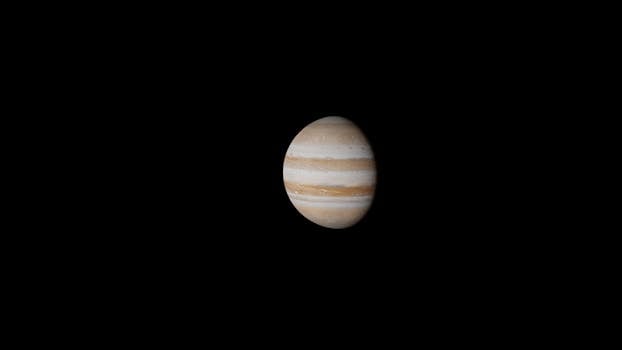
Jupiter, renowned for its stunning clouds and colossal size, is not only a visual marvel but a treasure trove of scientific data. The atmospheric features of Jupiter provide critical insights into its composition and meteorological phenomena. This article examines what makes up Jupiter's clouds and why understanding them is vital for broader astronomical research.
Composition of Jupiter's Clouds
Jupiter's atmosphere is predominantly hydrogen and helium; however, the clouds that create its colorful facade are composed of various compounds:
.png)
- Ammonia Ice: The topmost cloud layer is primarily made of ammonia crystals, giving Jupiter a white appearance.
- Ammonium Hydrosulfide Crystals: Below the ammonia layer, this middle layer contributes to the different colors seen on Jupiter.
- Water Ice and Vapor: The deepest layer that can be observed using telescopes consists of water in both ice and vapor forms.
These layers differ not just in composition but also in temperature and density, influencing their dynamics and interaction.
Techniques for Studying Jupiter's Clouds
Exploring the composition of Jupiter's clouds involves several sophisticated techniques:
- Telescopic Observations: Utilizing both ground-based and orbital telescopes, like the Hubble Space Telescope, astronomers can capture detailed images of Jupiter's atmosphere.
- Spacecraft Missions: Probes like NASA's Juno provide direct measurements from Jupiter's orbit, offering unprecedented insight into its atmospheric conditions.
- Spectroscopy: By examining the light absorption and emission from Jupiter's clouds, scientists can deduce which molecules are present.
These methods complement each other, providing a comprehensive understanding of Jupiter's atmospheric makeup.
Insights from the Juno Mission
NASA's Juno spacecraft has been instrumental in enhancing our knowledge of Jupiter's clouds. Juno's sensors have detected:
- Water: Indicative of how Jupiter may have formed.
- Ammonia: Helps in understanding the vertical structure of the clouds.
- Methane and Hydrogen Sulfide: Key to studying the chemical reactions within Jupiter's atmosphere.
The data from Juno helps decipher the cloud composition at different depths and contributes to our understanding of Jupiter's weather patterns and their implications for the planet's formation and evolution.
Importance of Understanding Jupiter's Clouds
Studying Jupiter's atmospheric composition is crucial for several reasons:
- Planetary Formation: Insights into Jupiter's atmosphere provide clues about the processes involved in the formation of planetary bodies.
- Exoplanetary Research: Understanding Jupiter can help predict and model the atmospheres of exoplanets, some of which may share similar characteristics.
- Meteorology: Jupiter's dynamic weather systems, including its famous Great Red Spot, offer a parallel to studying atmospheric behavior on a grand scale.
In essence, Jupiter serves as both a laboratory and a benchmark for planetary science, helping us understand not just our own solar system but also informing our knowledge of planets beyond our cosmic neighborhood.
Conclusion
Jupiter's clouds are more than just a visual spectacle; they are windows into the planet's internal workings and history. Through ongoing research and future missions, we hope to unlock further secrets of Jupiter's atmosphere, enhancing our understanding of the universe. As our tools and techniques evolve, so too will our capabilities to probe deeper into this giant planet's enigmatic clouds, continuing to expand the frontiers of space exploration and knowledge.