Exploring the Depths of Jupiter's Atmosphere: A Closer Look at the Gas Giant
Jupiter, the behemoth of our solar system, has long captured the interest of scientists and astronomy enthusiasts around the world. With its massive size and visually striking cloud bands, Jupiter provides a unique window into the atmospheric dynamics of gas giants. This article delves deeper into the characteristics of Jupiter's atmosphere, examining its composition, weather systems, and the pivotal role of space missions in expanding our understanding of this enormous planet.
Composition of Jupiter's Atmosphere
.png)
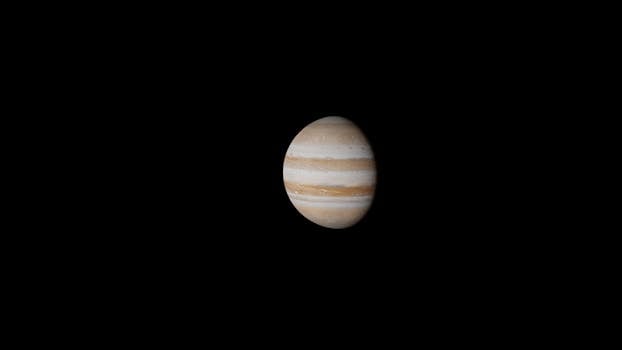
Jupiter's atmosphere is predominantly composed of hydrogen and helium, mirroring the elemental makeup of the sun. This similarity supports theories suggesting that Jupiter could have become a star had it amassed sufficient mass during the solar system's formation. Minor components of the atmosphere include ammonia, methane, water vapor, and silicon-based compounds, which contribute to the vibrant cloud bands and the iconic Great Red Spot—a storm larger than Earth that has persisted for centuries.
Temperature and Pressure Variations
The atmosphere of Jupiter experiences a dramatic increase in temperature and pressure from the outer layers inward. On the outermost layer, temperatures plummet to approximately -145 degrees Celsius (-230 degrees Fahrenheit). Moving towards the planet's core, temperatures rise significantly, enough to melt metals such as iron and nickel, leading to the formation of metallic hydrogen—a phase of hydrogen that behaves like an electrical conductor, found only under the extreme pressures within Jupiter.
Jupiter's Dynamic Weather Patterns
Jupiter's rapid rotation, completing a turn on its axis approximately every 10 hours, significantly influences its atmospheric dynamics. This quick rotation fosters the formation of strong jet streams and turbulent storms, with wind speeds that can top 620 kilometers per hour (385 miles per hour). The Great Red Spot, a hallmark of Jupiter's weather, highlights the intensity and scale of meteorological phenomena on the gas giant.
Impact of Space Missions on Our Understanding
Our knowledge of Jupiter's atmospheric conditions has been greatly enhanced by space missions, including Voyager, Galileo, and the more recent Juno mission. These missions have provided unprecedented high-resolution images and data, shedding light on the complex atmospheric phenomena. Juno, in particular, has been crucial in revealing new features such as the massive cyclones at Jupiter's poles and the deep atmospheric structures underlying the Great Red Spot.
Scientific and Practical Implications
Studying Jupiter's atmosphere extends beyond mere scientific curiosity. It offers a macroscopic model for understanding weather systems, which can be instrumental in enhancing meteorological models on Earth. Furthermore, insights gained from Jupiter can inform our understanding of planetary formation and evolution, aiding in the study of other planetary systems both within and beyond our solar system.
Conclusion
Jupiter's atmosphere is a dynamic entity, shaped by its chemical composition, swift rotation, and internal heat. The ongoing exploration of this gas giant not only helps us to comprehend the broader workings of the universe but also enriches our understanding of planetary science. As space exploration technology evolves, we anticipate discovering more about Jupiter's atmospheric secrets, continuing to feed our intrigue with this majestic planet.