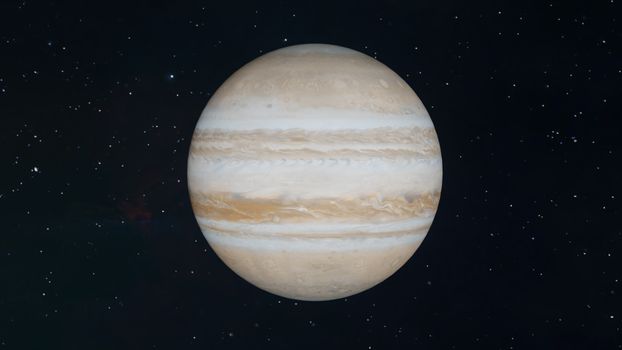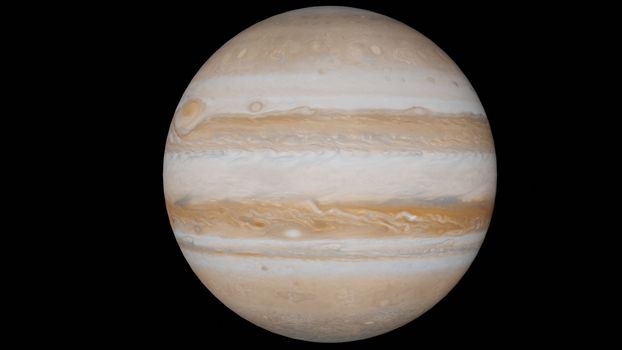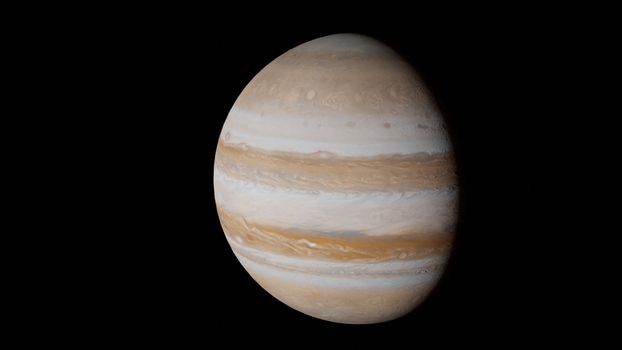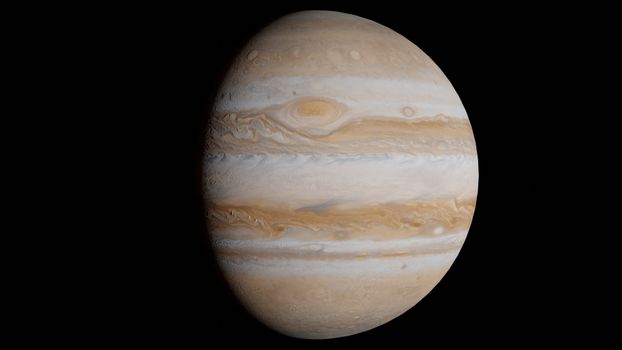
Jupiter is a planet of superlatives: the largest in our solar system, a swirling ball of gas and storms, and a cosmic heavyweight with a gravitational pull that shapes the fate of comets, asteroids, and even planets. Yet, for all we know about its dramatic atmosphere and enormous magnetic field, the greatest mysteries lie hidden beneath its clouds. What is at the very heart of Jupiter? What secrets does its core hold about planetary formation, the origins of our solar system, and the physics of matter itself? Join us on a journey deep inside Jupiter—a voyage to an environment so extreme it challenges the limits of human understanding and technology.
Peeling Back Jupiter’s Layers: An Overview of Its Internal Structure
Jupiter might appear as a simple ball of gas, but its internal structure is remarkably complex. Scientists have pieced together a model of Jupiter’s innards using data from telescopes, planetary missions, and physics experiments replicating the planet’s extreme conditions.
Beneath its turbulent cloud tops—home to the iconic Great Red Spot—Jupiter is structured in distinct layers:
.png) 1. $1 The outermost layer, about 5,000 km deep, consists mainly of hydrogen and helium, with traces of ammonia, methane, and water vapor. Winds here can reach up to 620 km/h (385 mph).
2. $1 Below the atmosphere, pressure increases and hydrogen exists as a molecular gas.
3. $1 At pressures above 1.4 million times Earth's atmosphere, hydrogen becomes metallic—an exotic state where hydrogen atoms lose their electrons and electricity flows freely. This layer is thought to be roughly 40,000 km thick.
4. $1 At the center, scientists believe there is a dense core, possibly made of rock, metal, and ice, surrounded by a fuzzy, partially dissolved layer.
1. $1 The outermost layer, about 5,000 km deep, consists mainly of hydrogen and helium, with traces of ammonia, methane, and water vapor. Winds here can reach up to 620 km/h (385 mph).
2. $1 Below the atmosphere, pressure increases and hydrogen exists as a molecular gas.
3. $1 At pressures above 1.4 million times Earth's atmosphere, hydrogen becomes metallic—an exotic state where hydrogen atoms lose their electrons and electricity flows freely. This layer is thought to be roughly 40,000 km thick.
4. $1 At the center, scientists believe there is a dense core, possibly made of rock, metal, and ice, surrounded by a fuzzy, partially dissolved layer.
The exact composition and size of Jupiter's core remain hotly debated. Recent data from NASA's Juno spacecraft suggest the core may be larger and more diffuse than previously thought, possibly spanning 30-50% of the planet's radius.
The Extreme Physics Inside Jupiter: Pressure, Temperature, and Composition
Descending into Jupiter is like entering a natural laboratory for the extremes of physics. The further you go, the more intense the environment becomes:
- $1 At the cloud tops, pressure is about 1 bar (similar to Earth's surface). By the time you reach the core, pressures soar to an estimated 35-45 million bars—more than 40 million times Earth's atmospheric pressure. - $1 Temperatures rise from around -145°C (-234°F) in the upper atmosphere to about 24,000°C (43,000°F) near the core—hotter than the surface of the Sun. - $1 Jupiter's overall density is 1.33 g/cm³, but at the core, it may be as high as 20-30 g/cm³.The planet is composed mainly of hydrogen (about 90% by atom count) and helium (about 10%), with trace amounts of heavier elements. These elements are believed to be more concentrated toward the center, forming the foundation of Jupiter’s “core.”
Journey to the Core: What Would Descent into Jupiter Be Like?
If you could somehow survive the trip, what might you encounter on a descent to Jupiter’s core? Let’s embark on a hypothetical journey:
- $1 Entry begins with ammonia clouds, lightning storms, and hurricane-force winds. - $1 As you fall, pressure increases rapidly. Any spacecraft would need to withstand crushing forces far beyond the limits of current technology. - $1 About halfway down, you’d enter the vast layer of metallic hydrogen. Here, hydrogen behaves like an electrical conductor, generating Jupiter’s powerful magnetic field (the strongest in the solar system, at 20,000 times Earth's). - $1 The environment becomes so dense and hot that atoms are stripped of their electrons. The surrounding material may be a "fuzzy" mixture of rock, ice, and metallic hydrogen, with no clear boundary.No probe or human has ever ventured beyond Jupiter’s upper atmosphere. The Galileo probe (1995) survived for less than an hour before being destroyed by heat and pressure at only 200 km below the cloud tops—barely scratching the surface of Jupiter’s true depths.
Jupiter’s Core: What Do We Know and Why Does It Matter?
The nature of Jupiter's core has profound implications for planetary science. There are three main theories about its structure:
1. $1 Jupiter has a compact core made of rock and ice, about 10–20 times the mass of Earth. 2. $1 The core exists, but it's mixed with surrounding hydrogen and helium, resulting in a "fuzzy" or "diffuse" core. 3. $1 Jupiter formed without a significant dense core, and heavier elements are spread throughout the planet.NASA’s Juno mission, orbiting Jupiter since 2016, uses gravitational measurements to probe beneath the clouds. Its data suggest the core is not compact but spread out, possibly due to a colossal collision early in Jupiter’s history.
Understanding Jupiter’s core helps scientists answer big questions:
- $1 Did Jupiter build up from a rocky core, or did it form directly from gas? This affects how we think about exoplanets and the birth of solar systems. - $1 Knowing where the heavy elements are tells us about the materials present in the early solar system. - $1 The core’s structure influences Jupiter’s magnetic field, heat flow, and even its weather patterns.Comparing Jupiter’s Core to Other Planets
How does Jupiter’s mysterious core stack up against those of other planets? See the comparison below:
| Planet | Core Composition | Estimated Core Size (Earth Masses) | Core State | Pressure at Core (bars) |
|---|---|---|---|---|
| Jupiter | Rock, metal, ice (possibly diffuse) | 10–20 | Uncertain (solid or diffuse) | 35–45 million |
| Saturn | Rock, ice, metal | 9–22 | Probably solid | 8–10 million |
| Earth | Iron, nickel | 1 | Solid inner, liquid outer | 3.6 million |
| Neptune | Rock, ice | 1.2–1.7 | Solid | 7 million |
Jupiter’s core is both massive and enigmatic. While Earth’s core is well-defined and metallic, Jupiter’s may be diluted and mixed with its surroundings, challenging our understanding of how giant planets grow and evolve.
How Scientists Study Jupiter’s Hidden Depths
Since direct exploration is impossible, how do we learn about Jupiter’s interior?
- $1 By precisely tracking the motion of spacecraft like Juno as they fly by Jupiter, scientists can detect tiny changes in gravity caused by variations in the planet’s mass distribution. This reveals clues about the internal structure. - $1 Jupiter’s magnetic field is generated deep inside. Mapping its strength and shape helps infer what’s happening far below the clouds. - $1 Physicists use powerful lasers and diamond anvil cells to compress hydrogen and helium to Jupiter-like pressures, observing how these materials behave. - $1 Supercomputers model Jupiter’s interior using physics equations, predicting how different core structures would affect observable properties.While these methods are powerful, significant mysteries remain. For example, Juno’s data imply there may be more heavy elements in Jupiter than expected—possibly up to 10% of its total mass.
The Broader Impact: What Jupiter’s Core Teaches Us About the Universe
Jupiter is not just a fascinating planet in its own right; it’s a Rosetta Stone for planetary science. Here’s why its core matters far beyond our solar system:
- $1 Thousands of gas giants have been discovered orbiting other stars. By understanding Jupiter’s interior, we can interpret the masses, sizes, and compositions of these distant worlds. - $1 Jupiter’s formation influenced the locations and fates of other planets, moons, and asteroids. Its core holds clues to the solar system’s earliest days. - $1 Studying Jupiter pushes the boundaries of physics, providing real-world laboratories for understanding matter at pressures and temperatures impossible to replicate on Earth.As missions like Juno continue, and as technology advances, we edge closer to unlocking the secrets at the heart of the giant planet.
Final Reflections: The Ongoing Quest to Understand Jupiter’s Core
Jupiter’s core remains one of the most tantalizing mysteries in planetary science. Its sheer size, extreme conditions, and the challenge of peering beneath thousands of kilometers of swirling clouds make it a frontier for exploration and discovery. Each new mission, from Galileo to Juno, delivers data that challenge old assumptions and spark new questions.
As we learn more about Jupiter, we uncover not just the secrets of a single planet, but the story of how worlds are born, how solar systems evolve, and how the laws of nature operate at their most extreme. The journey to the core of Jupiter is far from over—and the next breakthrough may be just around the corner.