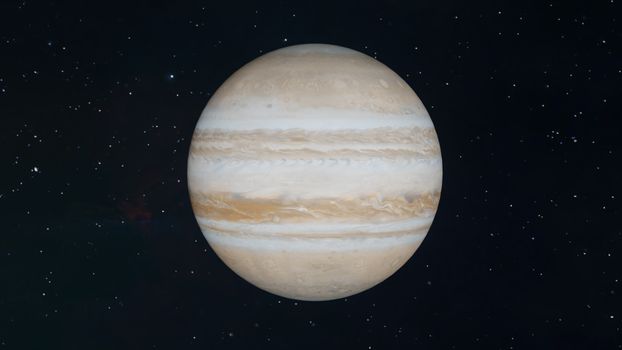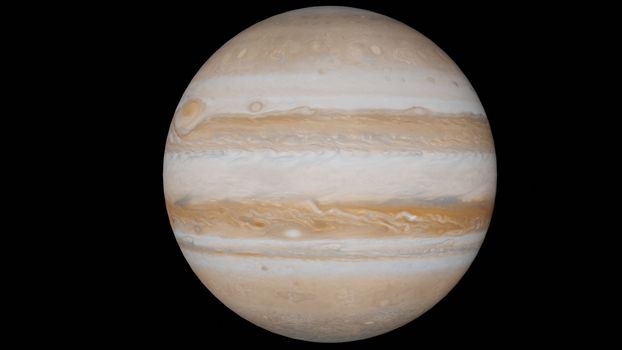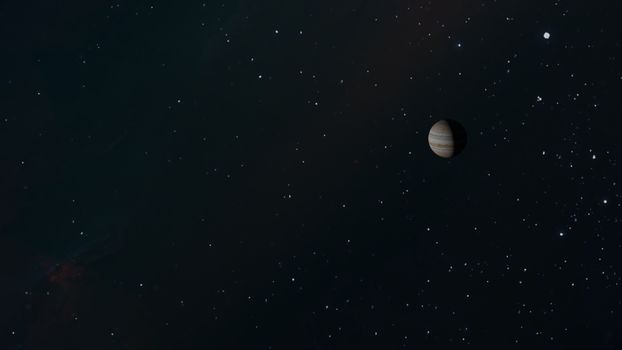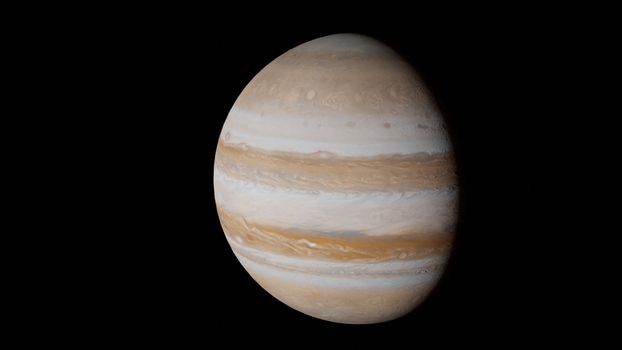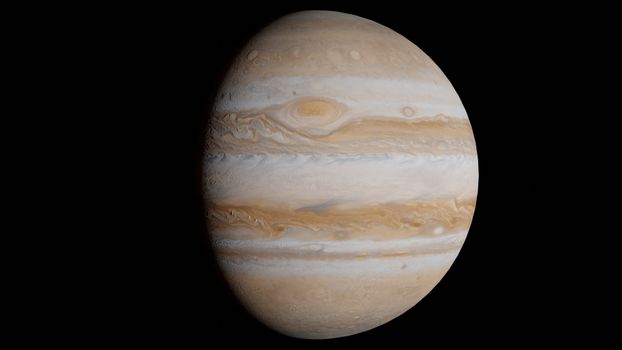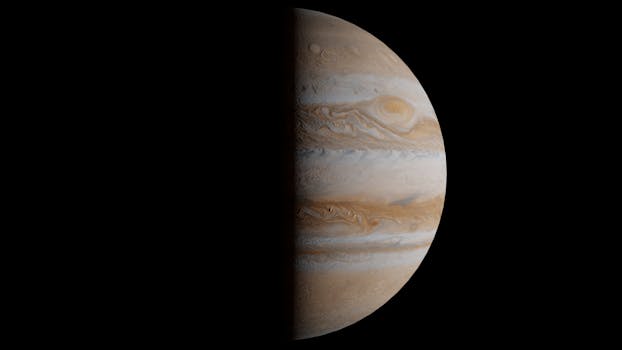
Jupiter, the solar system’s largest planet, is renowned for its immense gravitational pull—a force so powerful that it not only shapes the orbits of its own moons and Trojan asteroids, but also exerts a far-reaching influence well beyond its immediate neighborhood. One of the most intriguing realms affected by Jupiter’s gravity is the Kuiper Belt, a vast expanse of icy bodies and dwarf planets that lies beyond Neptune. But how exactly does Jupiter, stationed hundreds of millions of kilometers away, impact this distant region? The answer reveals fascinating insights into the architecture of our solar system, the migration of planets, and the mysterious origins of comets and other trans-Neptunian objects.
Jupiter’s Gravitational Reach: Beyond the Asteroid Belt
Jupiter’s gravity is formidable; with a mass 318 times that of Earth and a gravitational pull 2.5 times stronger than our planet's, it acts as a cosmic shepherd. Its gravitational sphere of influence, called the Hill sphere, extends 53 million kilometers, but its effects can be felt much farther through gravitational resonances and perturbations.
While Jupiter famously shapes the asteroid belt and diverts comets, its influence isn’t confined to the inner solar system. Through a series of complex gravitational interactions, particularly during the early evolution of the solar system, Jupiter’s gravity has played a pivotal role in sculpting the outer solar system, especially the Kuiper Belt. Despite being, on average, over 750 million kilometers (466 million miles) from the inner edge of the Kuiper Belt, Jupiter’s mass is so great that its gravitational reach—amplified through interactions with other giant planets—has lasting consequences even this far out.
.png)
The Kuiper Belt: A Cosmic Reservoir Under Distant Influence
The Kuiper Belt is a doughnut-shaped region extending from about 30 AU (astronomical units) to 50 AU from the Sun, just beyond Neptune’s orbit (1 AU is the distance from the Earth to the Sun, approximately 150 million kilometers). It is home to dwarf planets like Pluto, Haumea, and Makemake, as well as tens of thousands of icy bodies larger than 100 kilometers across, and possibly millions of smaller objects.
Though Neptune is the closest giant planet to the Kuiper Belt, Jupiter’s gravitational influence indirectly shapes the population and distribution of Kuiper Belt Objects (KBOs). Through a process known as planetary migration, as well as ongoing resonant and scattering effects, Jupiter has helped determine which objects remain in the Kuiper Belt and which have been ejected or sent inward toward the Sun.
Planetary Migration and the Shaping of the Kuiper Belt
One of the most dramatic episodes in the early solar system was the migration of the giant planets. According to the widely supported Nice Model, Jupiter and Saturn migrated inward and then outward over millions of years, due to interactions with a massive disk of planetesimals—small, early solar system bodies—that once existed beyond their orbits.
As Jupiter migrated, its gravity, in tandem with Saturn and the other giants, caused a “gravitational shake-up.” This process scattered countless icy objects from their original orbits, reshaping the Kuiper Belt and even creating the Oort Cloud, a distant shell of comets surrounding the solar system.
Key points about Jupiter’s role in planetary migration and its effect on the Kuiper Belt: - Jupiter’s inward and outward migration destabilized the orbits of planetesimals in the outer solar system. - This led to the scattering of many objects into the Kuiper Belt, while others were ejected from the solar system or sent into the inner solar system as comets. - The current structure of the Kuiper Belt, including its sharp outer edge at about 50 AU, is thought to be a legacy of these early gravitational disruptions. - Computer simulations suggest that up to 99% of the original planetesimals in the outer solar system were ejected or relocated, leaving only a small fraction as the modern Kuiper Belt.Resonances: The Hidden Hand of Jupiter
Even today, Jupiter’s gravity continues to influence the Kuiper Belt, albeit indirectly, through the complex phenomenon of orbital resonances. An orbital resonance occurs when two orbiting bodies exert a regular, periodic gravitational influence on each other, usually because their orbital periods are related by a ratio of whole numbers.
While Neptune’s resonances are most prominent in the Kuiper Belt (for example, Pluto orbits in a 3:2 resonance with Neptune), Jupiter’s powerful gravitational field can modify these resonances. For instance, certain regions of the Kuiper Belt are depleted of objects—these are called “resonance gaps”—because Jupiter and Saturn’s combined gravitational tugs have rendered those orbits unstable.
A famous example is the so-called “Kirkwood gaps” in the asteroid belt, which are mirrored in the Kuiper Belt by similar voids created by overlapping resonances involving Jupiter and the other giants. This resonance overlap can lead to chaotic orbits, causing some KBOs to be ejected from the belt or thrown into the inner solar system.
Dynamical Scattering and the Journey of Short-Period Comets
Another major influence of Jupiter’s gravity on the Kuiper Belt is its role in the creation and evolution of short-period comets. While long-period comets originate from the remote Oort Cloud, most short-period comets (those with orbital periods less than 200 years) are thought to come from the Kuiper Belt or the “scattered disk”—a region of highly eccentric orbits at the outer edge of the belt.
Here’s how Jupiter plays a crucial role: - When a KBO’s orbit is perturbed (often by Neptune), it can be sent inward toward the Sun. - As it moves inward, Jupiter’s massive gravitational field can “capture” the object, altering its orbit and turning it into a short-period comet. - Jupiter can also eject these objects entirely from the solar system, or, in rare cases, send them crashing into the Sun or planets.Statistically, Jupiter is responsible for the ultimate fate of a vast majority of short-period comets. In fact, studies suggest that over 90% of KBOs that become short-period comets are either diverted by Jupiter or ejected from the solar system by its gravitational influence.
Comparing Gravitational Influences: Jupiter vs. Neptune on the Kuiper Belt
It’s natural to wonder: if Neptune is so close to the Kuiper Belt, why does Jupiter’s gravity matter? The answer lies in the combination of proximity and mass. While Neptune directly shepherds many objects, Jupiter’s mass gives it a disproportionately large gravitational sway.
Here’s a comparative overview:
| Planet | Mass (Earth Masses) | Distance to Kuiper Belt (AU) | Main Influence | Effect on KBOs |
|---|---|---|---|---|
| Jupiter | 318 | 15-20 (from its orbit at 5 AU to inner Kuiper Belt at 30 AU) | Gravitational perturbations, resonance, ejection | Indirectly sculpts belt, ejects KBOs, creates short-period comets |
| Neptune | 17 | 0 (orbits at 30 AU, adjacent to Kuiper Belt) | Direct resonance, orbital shepherding | Maintains resonant KBOs, sculpts outer belt structure |
Despite being 20 times farther from the Kuiper Belt than Neptune, Jupiter’s far greater mass means its gravitational perturbations, especially during planetary migration, have had—and continue to have—a profound effect on the population and dynamics of KBOs.
Evidence from Observations and Simulations
Astronomers have gathered compelling evidence for Jupiter’s influence on the Kuiper Belt through both direct observation and sophisticated computer simulations. Key findings include:
- The “cold classical” Kuiper Belt, a population of objects with low-inclination, circular orbits, appears undisturbed by planetary migrations, suggesting it is a remnant of the original belt. However, the more chaotic “scattered disk” objects owe their current orbits to past gravitational interactions involving Jupiter. - Recent studies using the Canada-France Ecliptic Plane Survey (CFEPS) estimate that only about 1% of the solar system’s original icy planetesimals remain in the Kuiper Belt today, with Jupiter responsible for ejecting or redirecting the vast majority. - Simulations show that Jupiter’s gravity, combined with that of Saturn, can stir up resonances in the Kuiper Belt that ripple out for billions of kilometers, explaining the observed gaps and clusters of objects.These lines of evidence reinforce the idea that Jupiter, despite its distance, has been a master architect of the solar system’s outer regions.
Lasting Impacts: Why Jupiter’s Influence on the Kuiper Belt Matters
Understanding Jupiter’s role in shaping the Kuiper Belt is more than an academic exercise. These insights help explain: - The origin of comets that may have delivered water and organic material to early Earth. - The distribution and composition of distant icy worlds, which are time capsules from the solar system’s infancy. - The potential for similar processes to occur in exoplanetary systems around other stars.Moreover, studying these interactions helps scientists develop models for planetary system formation and evolution—a crucial step in our quest to understand both our cosmic neighborhood and distant worlds.