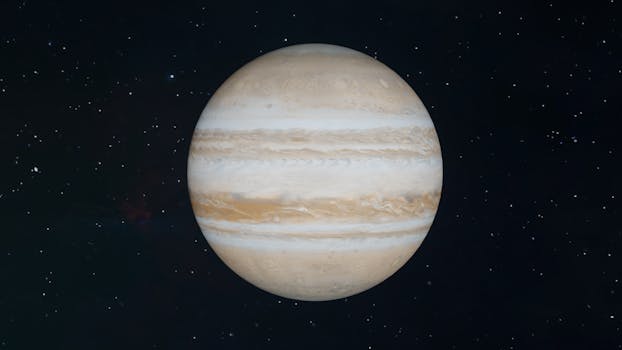
Jupiter and Its Magnetosphere: Shaping the Space Environment Around the Giant Planet
Jupiter, the largest planet in our solar system, is a world of extremes. Its swirling storms, enormous size, and complex family of moons have fascinated astronomers for centuries. Yet, one of Jupiter’s most remarkable and influential features is invisible to the naked eye: its magnetosphere. This vast magnetic bubble, generated deep within Jupiter’s churning interior, stretches millions of kilometers into space and profoundly alters the space environment around the gas giant.
To fully appreciate Jupiter’s magnetosphere is to glimpse a cosmic force field of staggering proportions. It not only shields Jupiter’s atmosphere from harsh solar winds, but also sculpts the orbits of nearby moons, shapes radiation belts, directs spectacular auroras, and even impacts the dynamics of the solar system itself. This article dives deep into the workings of Jupiter’s magnetosphere, exploring its origins, scale, and its powerful effects on the surrounding space environment.
The Origin of Jupiter’s Magnetosphere: A Planetary Dynamo
Every magnetosphere begins with a magnetic field, and Jupiter’s is the strongest of any planet in our solar system. This field is produced by a process known as the dynamo effect. Deep inside Jupiter, immense pressures transform hydrogen into an electrically conducting metallic form. As the planet rotates (in just under 10 hours), this metallic hydrogen churns and flows, generating electric currents that create a powerful magnetic field.
.png)
Jupiter’s magnetic field is tilted about 10 degrees relative to its rotational axis, causing the magnetosphere to wobble as the planet spins. Measurements from spacecraft such as Pioneer, Voyager, Galileo, and Juno reveal that Jupiter’s magnetic field at its equator is about 4.3 gauss—roughly 20 times stronger than Earth’s. Near the poles, it can reach up to 14 gauss, a figure unmatched elsewhere in the solar system.
Key facts: - Jupiter’s magnetic field is 20 times stronger than Earth’s at the equator. - The field is generated by metallic hydrogen, a phase unique to large gas giants. - Jupiter completes one rotation in just 9 hours and 55 minutes, driving powerful dynamo action.The Scale and Structure of Jupiter’s Magnetosphere
Jupiter’s magnetosphere is truly colossal, dwarfing any similar structure around a planet. If it could be seen from Earth, it would appear several times wider than the full moon. The magnetosphere extends up to 7 million kilometers toward the Sun—nearly 100 times Jupiter’s diameter—and trails off into a tail that stretches beyond Saturn’s orbit, over 600 million kilometers away.
The structure of the magnetosphere is divided into several regions: - The bow shock, where the solar wind slows abruptly on encountering Jupiter’s magnetic field. - The magnetosheath, a turbulent zone of shocked solar wind. - The magnetopause, the boundary between the shocked solar wind and Jupiter’s magnetic domain. - The inner and outer magnetosphere, each with distinct plasma populations and magnetic configurations.The inner magnetosphere, within about 10 Jupiter radii, is dominated by high-energy particles trapped by the magnetic field. Beyond that lies the plasma sheet, a massive current-carrying region loaded with material from Io, one of Jupiter’s volcanically active moons.
Comparing Magnetospheres: Jupiter Vs. Earth and Saturn
To grasp the enormity of Jupiter’s magnetosphere, it helps to compare it with those of Earth and Saturn. The following table outlines key differences:
| Feature | Jupiter | Earth | Saturn |
|---|---|---|---|
| Equatorial Magnetic Field Strength (gauss) | 4.3 | 0.3 | 0.2 |
| Magnetosphere Size (dayside, km) | 7,000,000 | 65,000 | 1,100,000 |
| Magnetotail Length (km) | >600,000,000 | 6,000,000 | >10,000,000 |
| Main Plasma Source | Io (volcanic moon) | Solar wind, ionosphere | Enceladus (icy moon) |
| Rotation Period (hours) | ~10 | 24 | ~10.7 |
Jupiter’s magnetosphere is not just the largest planetary magnetosphere in the solar system—it is also the most dynamic, shaped by both the planet’s rapid rotation and the constant input of charged particles from its volcanic moon Io.
Jupiter’s Magnetosphere: A Harsh Radiation Environment
One of the most significant effects of Jupiter’s magnetosphere is the creation of intense radiation belts. These belts, similar to Earth’s Van Allen belts but vastly more powerful, are filled with high-energy electrons, protons, and heavier ions. The source of many of these particles is Io, whose volcanoes erupt sulfur and oxygen into space. Once ionized, these particles become trapped by Jupiter’s magnetic field and accelerate to near-light speeds.
Radiation levels within Jupiter’s inner magnetosphere are so extreme that they can quickly damage spacecraft electronics and pose serious hazards to any future crewed missions. For example, NASA’s Juno spacecraft orbits Jupiter in a highly elliptical path to minimize time spent in the most dangerous radiation zones.
Specific numbers: - Radiation doses near Jupiter can exceed 20 million rads per day, compared to just a few hundred rads per day near Earth. - The most intense radiation is found within 3 Jupiter radii (about 215,000 kilometers from the planet’s center). - Juno’s electronics are shielded by a 200-kilogram titanium vault to survive the environment.Shaping the Space Environment: Moons, Rings, and Plasma Interactions
Jupiter’s magnetosphere is not an isolated bubble; it profoundly affects everything within its reach, especially the planet’s famous moons and faint ring system.
Io, the most volcanically active body in the solar system, ejects over 1 ton of material per second into space. This material forms a torus of plasma—an electrically charged doughnut—around Jupiter, fueling the magnetosphere and driving powerful electric currents. These currents connect Io to Jupiter’s upper atmosphere, sparking auroral emissions and heating the planet’s polar regions.
Europa, Ganymede, and Callisto, Jupiter’s other large moons, also interact with the magnetosphere. Ganymede is unique in having its own mini-magnetosphere within Jupiter’s, creating complex magnetic interactions.
The magnetosphere also sculpts Jupiter’s rings, which are composed largely of dust. High-energy plasma erodes ring particles, while electromagnetic forces help shape their structure and distribution.
Impact Beyond Jupiter: Influencing the Wider Solar System
Jupiter’s magnetosphere is so immense and energetic that its influence extends well beyond the immediate surroundings of the planet. The magnetotail, a long extension of the magnetosphere, sweeps through the orbits of Jupiter’s outer moons and even interacts with the solar wind far from the planet.
Some scientists believe that Jupiter’s magnetic field and its ability to sweep up charged particles may help shield the inner solar system from cosmic radiation. The magnetosphere’s interactions with the solar wind also generate radio emissions, detectable from Earth and used by astronomers to study both Jupiter and magnetic phenomena in other planetary systems.
Jupiter’s powerful magnetosphere also serves as a natural laboratory for understanding cosmic plasmas and magnetic fields, offering insights relevant to exoplanets, pulsars, and even the behavior of the Sun.
Looking Ahead: Why Jupiter’s Magnetosphere Matters
Studying Jupiter’s magnetosphere is not just an academic exercise. Its immense scale, intense radiation, and complex interactions provide a window into universal processes—from the workings of magnetic fields in other planets and stars to the evolution of planetary atmospheres and the habitability of moons.
Future missions, including the European Space Agency’s Jupiter Icy Moons Explorer (JUICE) and NASA’s Europa Clipper, will investigate how Jupiter’s magnetosphere shapes the environments of moons like Europa and Ganymede, both of which may harbor subsurface oceans.
Understanding the magnetosphere also has practical implications for spacecraft design, mission planning, and the safety of robotic and (perhaps one day) human explorers venturing into Jupiter’s domain.