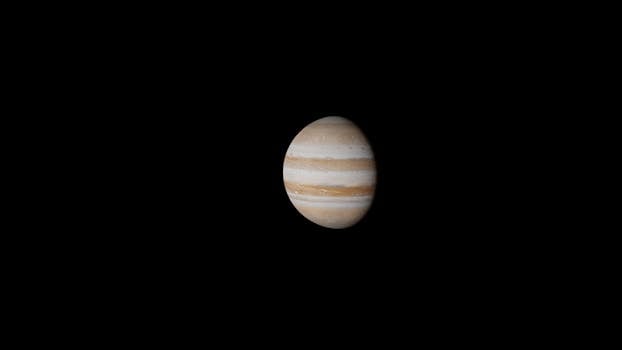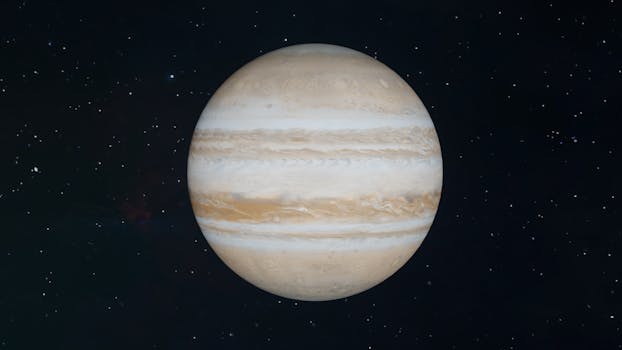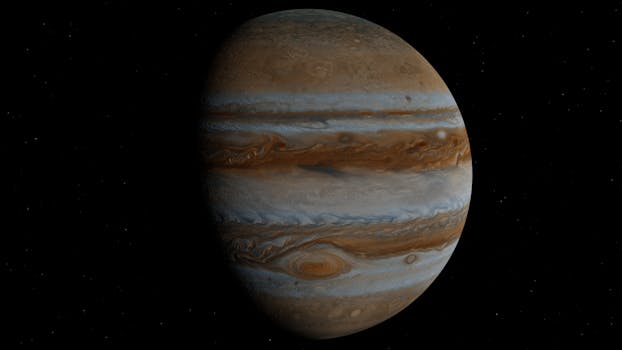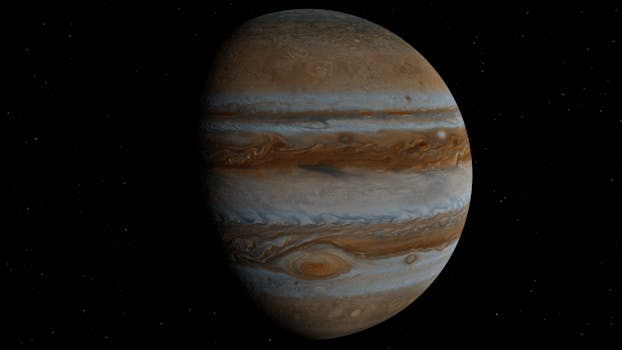
Jupiter, the behemoth of our solar system, has been a beacon for sky gazers and scientists alike for centuries. From its initial identification through rudimentary telescopes to sophisticated space missions, the exploration of Jupiter has significantly deepened our understanding of planetary science and the broader mechanics of our solar system.
Telescopic Discoveries The journey into Jupiter’s mysteries began with Galileo Galilei’s groundbreaking telescopic observations in 1610. Galileo discovered the first four of Jupiter’s moons – Io, Europa, Ganymede, and Callisto, known collectively as the Galilean moons. This discovery was pivotal as it challenged the then-prevailing geocentric model of the universe, which claimed all celestial bodies orbited Earth.
Subsequent advancements in telescope technology allowed astronomers to identify Jupiter’s atmospheric bands and its rapid rotation. Observations revealed that Jupiter was primarily composed of hydrogen and helium, suggesting its formation from the same solar nebula that gave birth to the Sun. This insight was crucial in shaping our understanding of how planets form in a burgeoning solar system.
.png)
Pioneering Space Missions The real thrust into Jupiter exploration began with NASA’s launch of the Pioneer 10 spacecraft in 1972, which made its closest approach to Jupiter in December 1973. This mission, and those that followed like Pioneer 11 and the Voyager series, provided unprecedented data on Jupiter’s magnetic field, radiation belts, and intricate ring system, revolutionizing our understanding of the giant planet.
The Galileo mission, arriving at Jupiter in 1995, marked a significant leap in our exploration efforts. Over its eight years in orbit, Galileo unveiled numerous discoveries, including signs of subsurface saltwater oceans on Europa. This finding fueled speculations about the potential for life in extraterrestrial environments, positioning Europa as a tantalizing site for future astrobiology missions.
Revolutionary Insights from Juno Launched in 2011, NASA’s Juno spacecraft, which began orbiting Jupiter in 2016, has provided spectacular close-up images and data. Its unique polar orbit has offered a fresh perspective on Jupiter’s polar cyclones and an even more intricate view of its magnetic fields. Early data suggest Jupiter may have a fluid interior, possibly comprising metallic hydrogen, which challenges previous models of Jupiter’s internal structure.
Implications and Future Endeavors The study of Jupiter serves a dual purpose. It not only helps scientists understand the giant planet itself but also offers insights into the broader dynamics of the solar system. For instance, Jupiter’s substantial gravitational influence plays a critical role in shaping the orbital paths of other solar system bodies and in shielding inner planets from comet and asteroid impacts.
Looking ahead, the exploration of Jupiter is set to continue with exciting new missions. The European Space Agency’s Jupiter Icy Moons Explorer (JUICE) and NASA’s Europa Clipper are poised to focus on the icy moons, particularly Europa, Ganymede, and Callisto, which are believed to harbor subsurface oceans and possibly even conditions amenable to life.
Conclusion From Galileo’s first peeks at Jupiter’s moons to contemporary probes diving into its swirling cloud tops, the exploration of Jupiter has been a journey of continual discovery. Each mission uncovers new layers of complexity about this giant planet and by extension, about our entire solar system. As we prepare for future missions, the enigmatic gas giant remains a key focus in our quest to understand the cosmos and our place within it.