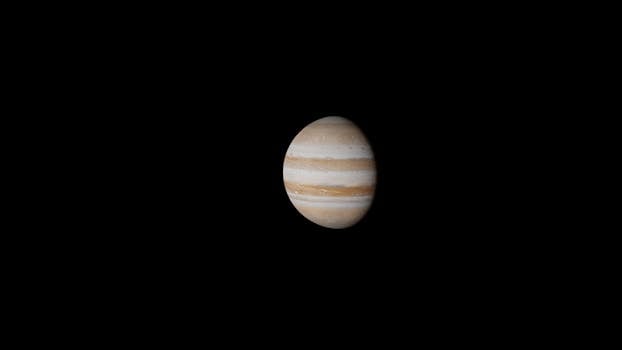
Jupiter, the largest planet in our solar system, intrigues scientists and astronomers with its immense size and striking cloud bands. Understanding Jupiter is essential for insights into our solar system's formation and the characteristics of other planetary systems.
Formation of Jupiter
Jupiter's formation is estimated to have started about 4.5 billion years ago, coinciding with the birth of the solar system itself. The process began from the collapse of a part of a giant molecular cloud that also led to the formation of the Sun. What followed was the creation of a protoplanetary disk composed of gas and dust around the Sun. Jupiter, having a substantial mass, likely formed first among the planets. It efficiently gathered hydrogen and helium, the most abundant elements in the universe, from this disk.
.png)
The core accretion model is commonly used to explain how Jupiter formed. According to this model, Jupiter first developed a solid core made from the accumulation of ice and rock particles. This core, once it reached a mass about 10 times that of Earth, started attracting a dense atmosphere of hydrogen and helium. This growth continued until Jupiter had absorbed most of the material available in its orbit, resulting in the gas giant we observe today.
Composition of Jupiter
Jupiter is primarily made up of hydrogen and helium, constituting roughly 99% of its mass. This composition mirrors that of the Sun, highlighting Jupiter’s origins from the solar nebula. The remaining 1% consists of heavier elements such as water, methane, ammonia, and traces of rock and metal, which likely form Jupiter’s core. Surrounding this core is a layer of metallic hydrogen, a unique state of hydrogen that acts as an electrical conductor under Jupiter’s extreme internal pressures and temperatures.
Jupiter’s Atmosphere and Magnetic Field
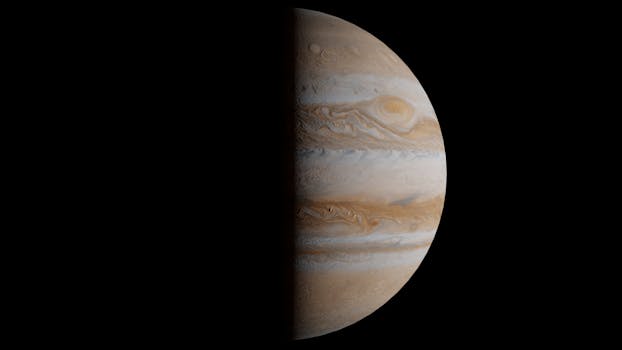
The atmosphere of Jupiter, characterized by its colorful bands and the iconic Great Red Spot, is one of its most distinctive features. The visible cloud layers are primarily composed of ammonia ice, but deeper layers consist of hydrogen and helium. The varying colors and patterns in the atmosphere result from differences in composition and temperature at various depths.
Jupiter also possesses the strongest magnetic field among the solar system’s planets, believed to be generated by the metallic hydrogen moving inside its core. This powerful magnetic field is responsible for creating spectacular auroras at Jupiter’s poles, akin to the auroras on Earth.
Scientific Importance of Jupiter
Studying Jupiter not only enhances our understanding of the early solar system but also aids in the investigation of exoplanets, particularly gas giants similar to Jupiter. By examining Jupiter, scientists can extrapolate properties of these distant worlds.
In conclusion, Jupiter is more than just a prominent feature in our night sky; it plays a pivotal role in the field of planetary science. Its formation and composition offer a narrative of the early solar system and pose engaging scientific challenges. As our capability to study celestial bodies advances, our knowledge of Jupiter will expand, providing further insights into our cosmic surroundings.