Jupiter, known as the behemoth of our solar system, holds a pivotal position in cosmic studies due to its immense size, intriguing atmospheric phenomena, and profound impact on the solar neighborhood. This article explores the evolutionary path of Jupiter, shedding light on its formation, dynamic atmospheric conditions, and its significant role in the architectural framework of our solar system.
Formation and Early Impact
Approximately 4.5 billion years ago, Jupiter began to take shape from the remnants of the solar nebula — the gas and dust cloud from which the Sun itself was born. Its location and size allowed it to gather more hydrogen and helium, the lightest and most abundant elements in the universe, than any other celestial body in the solar system. This accumulation resulted in the formation of a gas giant, consisting of a dense core enveloped by layers of thick gas.
.png)
During its formative years, Jupiter’s massive gravitational influence was instrumental in organizing the orbital paths of other objects in its vicinity. It effectively cleared its orbit by attracting or repelling smaller objects, thereby influencing the formation and arrangement of other planets. Furthermore, Jupiter’s gravitational force plays a protective role, shielding the inner planets from potential catastrophic comet impacts by either capturing these comets or slinging them back into the outer reaches of space.
Atmospheric Dynamics and Magnetic Field
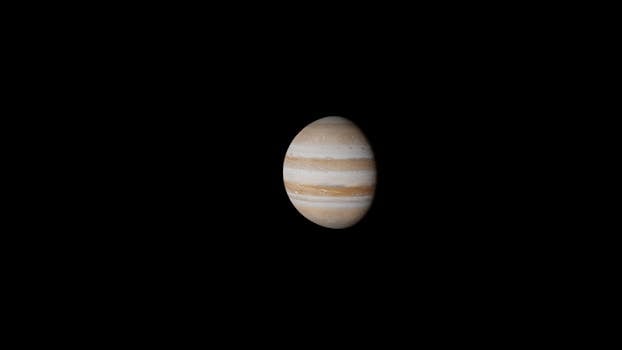
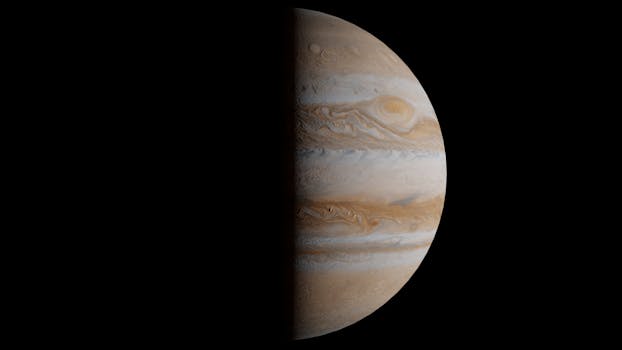
Jupiter's atmosphere, primarily composed of hydrogen and helium, also contains trace amounts of ammonia, methane, and water vapor, which contribute to its complex meteorological phenomena. The planet is famous for its visually striking features such as the colorful bands, caused by different gases at various altitudes, and the Great Red Spot, a gigantic storm persisting for at least four centuries. The persistence and scale of this storm highlight the intense and dynamic nature of Jupiter’s atmospheric activity.
One of the most remarkable features of Jupiter is its powerful magnetic field, the strongest in the solar system, generated by eddy currents in the metallic hydrogen layer deep within the planet. This magnetic field extends far into space, forming a vast magnetosphere that traps charged particles, including those spewed from Io, one of its moons. This creates a lethal radiation belt around the planet, making it one of the most challenging environments for space exploration.
Contributions to Planetary Science
The study of Jupiter has advanced significantly with missions like Pioneer, Voyager, and the more recent Juno probe, which have provided detailed data about the planet’s atmospheric conditions, magnetic fields, and internal structure. Juno’s findings, in particular, have offered unprecedented insights into Jupiter's internal dynamics, including the depth of its atmospheric bands and the nature of its core.
These explorations are crucial not only for understanding Jupiter itself but also for gaining broader insights into the formation of gas giants and the dynamics of planetary systems. Jupiter’s characteristics provide a comparative model for studying exoplanets, many of which are gas giants, thereby extending our knowledge of planet formation and the conditions that might support life.
Conclusion
Jupiter is more than just a prominent feature of our night sky; it is a complex, dynamic world with a profound story of cosmic evolution. Its study enhances our understanding of the solar system's history and offers guidance in our quest to decipher the mysteries of distant planetary systems. With ongoing technological advancements and future space missions, the exploration of Jupiter’s metamorphosis remains a central theme in planetary science, promising further revelations about this giant planet’s past, present, and future.