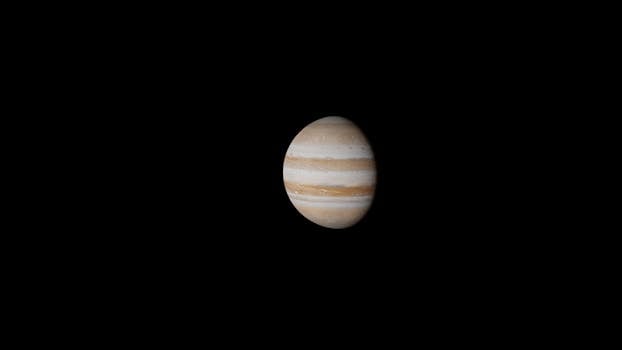
Jupiter, the largest planet in our solar system, has captivated the curiosity of scientists and astronomers for its massive size and dynamic atmosphere. Understanding Jupiter's chemical composition is not just crucial for gaining insights into its own structure and weather systems but also for shedding light on broader cosmic phenomena, including planetary formation and the characteristics of other gas giants both within and beyond our solar system.
Key Components of Jupiter's Atmosphere
At the heart of Jupiter's composition are hydrogen and helium, making up approximately 99% of the planet's atmosphere. This similarity to the sun's composition suggests that Jupiter has preserved much of the primordial material from the solar nebula that birthed our solar system. The small percentage of other gases present in Jupiter's atmosphere, though minor, play significant roles in shaping the planet's weather and appearance.
.png)
Trace Gases and Their Impact
The trace gases found in Jupiter's atmosphere include:
- Methane (CH4): This gas absorbs red light but reflects blue light, contributing to the blue hues observed in some parts of Jupiter’s atmosphere.
- Ammonia (NH3): Crucial for cloud formation, ammonia helps create the multiple cloud layers that contribute to Jupiter's striped appearance.
- Water Vapor (H2O) and Hydrogen Sulfide (H2S): These gases are involved in the dynamics of Jupiter’s weather patterns, including its storm systems.
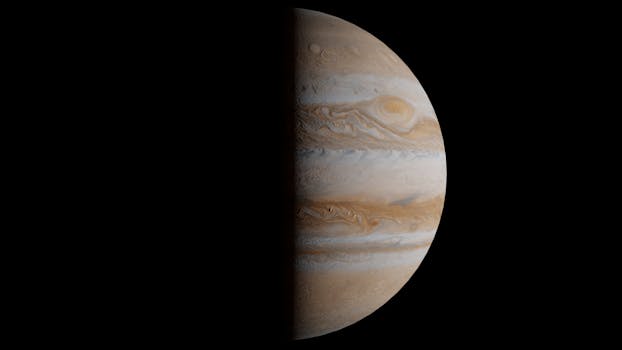
The iconic Great Red Spot, a gigantic storm larger than Earth that has been swirling for centuries, is a direct result of these atmospheric conditions. The colors seen in Jupiter’s atmosphere, ranging from deep reds to vibrant blues, are due to the absorption and reflection of sunlight by these gases.
Jupiter’s Internal Structure and Magnetic Field
Beyond its gaseous atmosphere, Jupiter is believed to possess a core composed of rock and metal, enveloped by a layer of metallic hydrogen. This metallic hydrogen is crucial as it conducts electricity and is responsible for generating Jupiter's extensive magnetic field, one of the most potent in the solar system.
Contributions of Space Missions
The exploration of Jupiter has been greatly enhanced by missions like NASA’s Juno spacecraft, which reached Jupiter in 2016. Juno's mission focuses on analyzing Jupiter’s composition, gravity field, magnetic field, and polar magnetosphere. By studying how mass is distributed within Jupiter, Juno provides essential data that helps scientists deduce the planet’s internal structure.
Broader Implications
Studying Jupiter’s composition also aids astronomers in understanding the processes that govern planetary formation and evolution. By examining Jupiter in comparison to other gas giants in our solar system and exoplanets around other stars, scientists can refine their theories on planetary development and the dynamics of solar systems.
Conclusion
The investigation into Jupiter’s chemical composition is pivotal not only for uncovering the secrets of the gas giant but also for enhancing our understanding of the solar system's early conditions and the fundamental processes that influence planetary systems. As our technological and explorative capabilities evolve, our knowledge of Jupiter and its complex systems will continue to expand, offering deeper insights into the universe's vast mysteries. This pursuit of knowledge underscores the importance of continued space exploration and scientific inquiry.