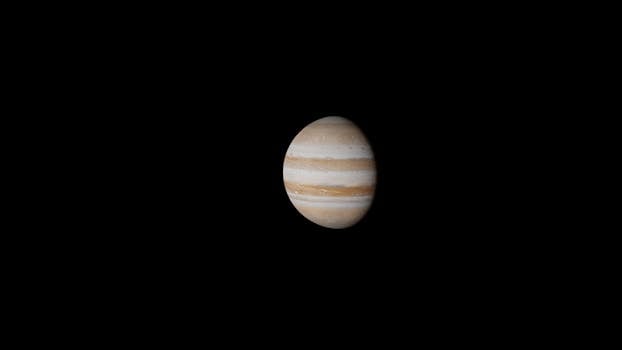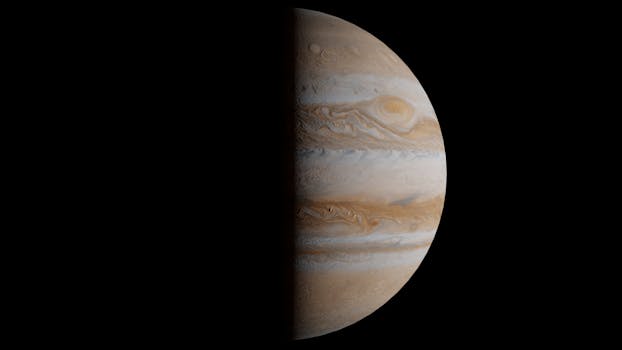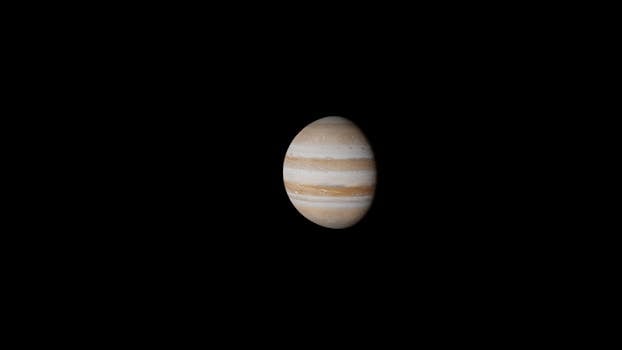
Jupiter, often called the behemoth of our Solar System, intrigues scientists and astronomy enthusiasts alike with its immense storms and beautiful, swirling cloud patterns. Yet, what lies beneath these mesmerizing features is equally fascinating. This exploration into the core of Jupiter aims to illuminate the complex internal structure of this giant planet and uncover both the known facts and the lingering mysteries.
Composition and Structure
Jupiter is predominantly composed of hydrogen and helium, mirroring the elemental composition of the sun and securing its classification as a gas giant. However, unlike the rocky planets such as Earth, Jupiter lacks a solid surface. Its atmosphere seamlessly transitions from a gaseous outer layer into deeper liquid states, and eventually, towards the mysterious core.
.png)
The visible layer of Jupiter’s atmosphere consists of intricate cloud bands formed from ammonia crystals, ammonium hydrosulfide, and water. These bands are strikingly apparent due to the variations in their temperature and chemical composition, shaped and shifted by Jupiter’s rapid atmospheric currents. The lighter bands, known as zones, are cooler and sit higher in the atmosphere, primarily composed of ammonia ice. Conversely, the darker bands, called belts, feature warmer, deeper clouds with a higher concentration of ammonium hydrosulfide.
Journey Deeper: From Gas to Metal
Delving deeper beneath these cloud layers, the environment within Jupiter becomes increasingly hostile, with temperatures and pressures rising to extraordinary levels. At approximately 13,000 kilometers below the clouds, the pressure is immense, and hydrogen gas is compressed into a form known as metallic hydrogen. In this exotic state, hydrogen molecules are so densely packed that their electrons become free-floating, rendering the hydrogen metallic and electrically conductive. This layer of metallic hydrogen is critical, as it likely plays a pivotal role in generating Jupiter’s extraordinarily strong magnetic field, the most intense of any planet in our Solar System.
The Enigmatic Core
The core of Jupiter is a profound mystery. Traditional models proposed a distinct, possibly rocky core, but recent insights from NASA’s Juno mission suggest that the reality is far more complex. Juno’s data indicates that Jupiter’s core might not be sharply defined but rather a diffuse and 'fuzzy' zone comprising a mix of rock and metallic hydrogen. This intriguing revelation has prompted scientists to reconsider existing theories on the formation of gas giants.
Why Jupiter’s Core Matters
Understanding the core of Jupiter is not just an academic pursuit; it holds practical implications for our broader understanding of planetary formation and evolution. As the likely first-formed planet in our solar system, Jupiter’s early accumulation of materials provides critical clues about the conditions and processes during the birth of our sun and its surrounding planets.
Moreover, Jupiter’s internal structure affects its gravitational field, which in turn influences the orbits of its moons and the stability of the solar system’s architecture. Detailed measurements from missions like Juno help refine our models of Jupiter’s mass distribution, enhancing our understanding of its internal dynamics.
Broader Implications for Exoplanet Studies
Beyond our solar system, Jupiter serves as a valuable analog for the study of exoplanets, many of which are gas giants. Insights gained from Jupiter can therefore inform our understanding of these distant worlds, aiding in the identification of potentially habitable environments and enhancing our knowledge of planetary system diversity across the galaxy.
Conclusion
While humans may never physically touch Jupiter’s core, the ongoing exploration and data collection provide a figurative journey into this giant planet’s heart. Each piece of data enriches our understanding, helping to unravel the solar system’s early history and the complex processes that govern planetary bodies. As we continue to probe and study Jupiter through missions like Juno and future endeavors, the giant planet will undoubtedly continue to reveal its secrets, playing a crucial role in our quest to understand the vast universe.