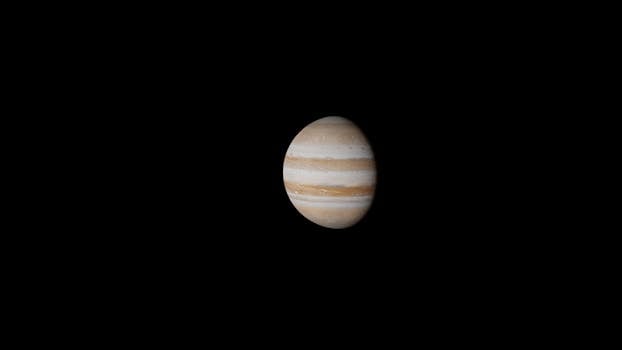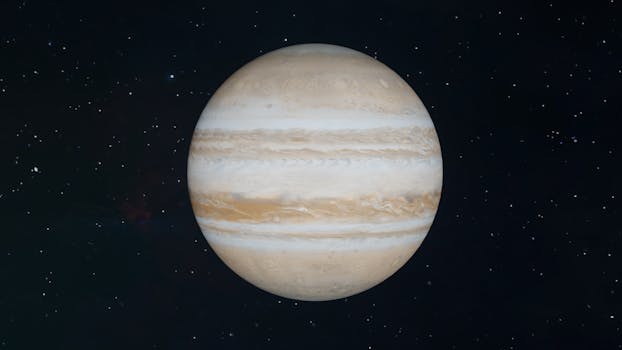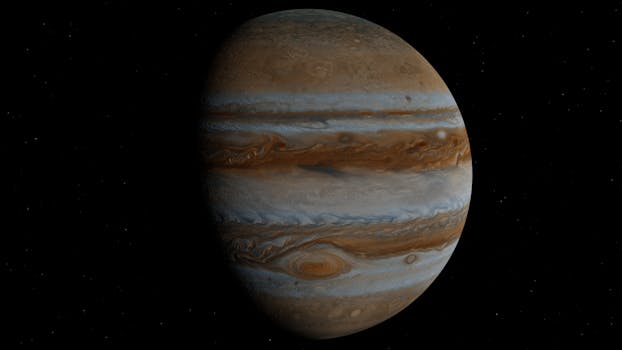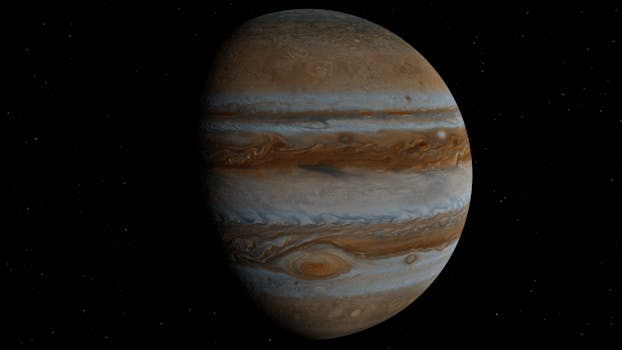
The Juno mission, launched by NASA, stands as a monumental venture aimed at unraveling the enigmas of Jupiter, the behemoth of our solar system. Since its departure on August 5, 2011, Juno has been pivotal in advancing our comprehension of the gas giant, offering insights into its atmosphere, magnetic field, and core structure.
Jupiter's allure stems from its massive size and visually captivating, swirling clouds. However, its harsh atmospheric conditions have posed significant challenges to in-depth scientific study. Juno’s mission has been uniquely designed to tackle these challenges by orbiting closer to Jupiter than any spacecraft before it, allowing for an unprecedented close-up examination of the planet.
Atmospheric Secrets Unveiled
.png)
Juno's primary goal is to dissect the layers of Jupiter’s atmosphere. Equipped with cutting-edge instruments, Juno measures critical components such as water and ammonia, probes the motion of clouds, and assesses the thermal structure of the atmosphere. These observations are crucial for understanding the planet's origin and its development over billions of years.
Magnetic Mysteries Explored
Exploring Jupiter’s extensive magnetosphere is another focal point of Juno’s mission. The spacecraft studies the magnetic forces at play using its Magnetometer (MAG), which examines the magnetic field's strength and structure. Additionally, instruments like the Jovian Auroral Distributions Experiment (JADE) and the Jupiter Energetic Particle Detector Instrument (JEDI) analyze the energetic particles within the magnetosphere. These studies are vital for understanding not only Jupiter’s magnetic properties but also those of other celestial bodies in our solar system.
Probing the Planetary Core
Juno also scrutinizes Jupiter’s core by measuring the planet’s gravitational field, which helps infer the internal mass distribution. Determining whether Jupiter possesses a solid core or a dense mixture of heavy elements at its center can provide significant insights into the solar system’s early days and the formation of its planets.
The Role of JunoCam in Public Engagement
An innovative aspect of Juno’s mission is its public outreach component, embodied by JunoCam. This camera captures stunning images of Jupiter’s poles and cloud tops, areas previously unseen on such a scale. These images not only contribute to scientific data but also engage and captivate the public, enhancing their interest in Jupiter and space exploration.
Continued Discoveries and Future Prospects
Juno’s findings have profoundly transformed our understanding of Jupiter. Discoveries such as the deeper extent of the Great Red Spot and the massive cyclones at the poles have overturned earlier conceptions of the planet’s atmospheric dynamics. Despite the intense radiation and powerful magnetic fields surrounding Jupiter, Juno’s specially designed radiation vault ensures it remains operational, continuously sending valuable data back to Earth.
Scheduled to continue until September 2025, the Juno mission promises even more revelations about Jupiter. Each orbit enriches our knowledge, refining our theories about this massive planet. The data gathered extends beyond Jupiter, enhancing broader planetary science and deepening our grasp of the universe.
In essence, NASA’s Juno mission is a cornerstone of modern space exploration. By demystifying the complexities of Jupiter, it provides not only a clearer picture of the gas giant but also illuminates the processes that shaped our entire solar system. As Juno continues to send data, the scientific community eagerly anticipates further discoveries that will expand our understanding of the cosmos.