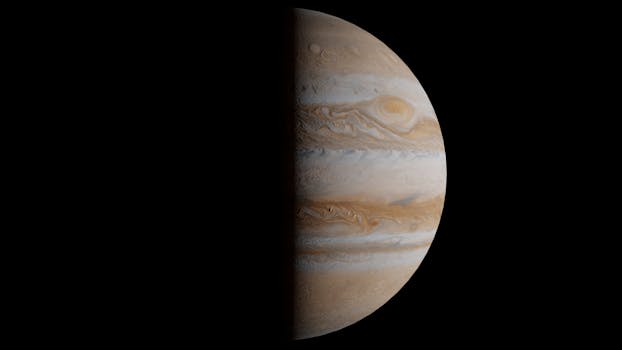
The Magnetic Field of Jupiter: A Comprehensive Study
Jupiter, renowned for being the largest planet in our solar system, also boasts the strongest magnetic field among the planets, profoundly influencing both its atmosphere and the surrounding space environment.
Origin and Mechanism
.png)
The source of Jupiter's magnetic field lies in its core, which comprises metallic hydrogen. Under the extreme pressures and temperatures within Jupiter, hydrogen exists in a metallic, liquid state, making it electrically conductive. As the planet rotates, this liquid metallic hydrogen moves, creating a dynamo effect that generates a powerful magnetic field.
Characteristics of Jupiter's Magnetic Field
One of the most compelling attributes of Jupiter's magnetic field is its sheer intensity and complex structure. The magnetic field strength at the poles is nearly ten times that of Earth's, marked by significant tilts and multiple, irregular poles rather than a simple, well-aligned dipole like Earth's. This complex magnetic structure is responsible for the creation of Jupiter’s intense radiation belts, far surpassing the strength of Earth's Van Allen belts.
Implications for Space Exploration
The magnetic field of Jupiter presents both challenges and opportunities for space exploration. The intense radiation, a byproduct of the strong magnetic field, poses a formidable challenge for spacecraft and any potential manned missions. Understanding the nuances of this magnetic field is crucial for designing robust spacecraft capable of enduring such severe conditions.
Jupiter's Magnetosphere
Jupiter's magnetosphere, sculpted by its magnetic field, is the largest of any planet in our solar system. Stretching up to 3 million kilometers towards the Sun, it nearly reaches the orbit of Saturn. This vast magnetosphere is teeming with plasma and controls the charged particles within its reach, playing a pivotal role in phenomena such as the spectacular auroras observed at Jupiter’s poles.
Scientific and Exoplanetary Relevance
The study of Jupiter’s magnetic field extends beyond our solar system, offering valuable insights into the magnetic fields of exoplanets. By understanding Jupiter's magnetic dynamics, scientists can better predict and model the magnetic environments of distant planets, potentially identifying those that may host life.
Recent Discoveries and Future Prospects
Data from recent missions like NASA’s Juno spacecraft have been instrumental in unraveling the complexities of Jupiter’s magnetic field. Juno’s close orbital paths around the planet have allowed for detailed measurements and provided new insights into the field's structure and dynamics, prompting the development of refined models and theories.
Conclusion
Jupiter’s magnetic field is a gateway to deeper astronomical understanding, bridging the gap between planetary science and broader cosmic phenomena. Its study not only enhances our knowledge of Jupiter but also enriches our understanding of planetary formation and behavior across the universe. As our technological capabilities evolve, so too will our insights into this giant planet's magnetic mysteries, continuing to fascinate and challenge astronomers and scientists around the world.
In essence, Jupiter's magnetic field is not just a feature of interest but a dynamic force that shapes our understanding of the solar system and beyond.