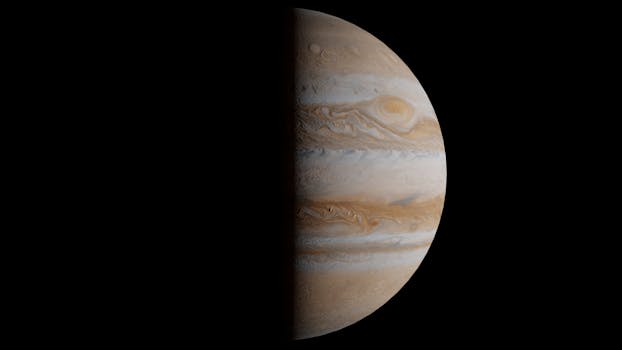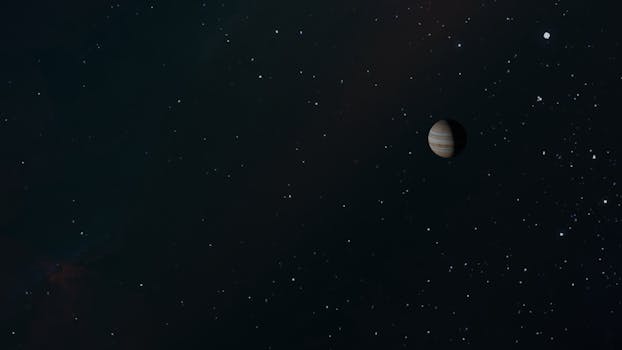
Jupiter, the behemoth of our solar system, not only stands out due to its sheer size but also due to its extraordinarily powerful magnetosphere. This magnetic field, the strongest of any planet in our solar system, reaches millions of kilometers into space, extending well beyond Jupiter itself. It significantly influences the space environment around Jupiter, particularly impacting its many moons. Analyzing how Jupiter’s magnetosphere interacts with its moons offers key insights into the dynamics of celestial bodies across the universe.
Origin of Jupiter’s Magnetosphere
The magnetosphere is mainly generated by Jupiter's internal dynamo, driven by the rapid rotation of its metallic hydrogen core. Jupiter rotates faster than any other planet in our solar system, which helps create a magnetic field about 20,000 times stronger than Earth's. It is so expansive that if visible from Earth, it would appear several times the size of the full moon.
.png)
Impact on Moons
Radiation Belts
One of the most critical effects of Jupiter's magnetosphere is the creation of intense radiation belts, akin to Earth's Van Allen belts but much more powerful. These belts, composed of highly energetic particles trapped by the magnetic field, constantly bombard moons such as Io, Europa, and Ganymede. This bombardment has significant implications for their surfaces and any existing atmospheres.
Io
Io, the innermost of Jupiter’s large moons, is the most volcanically active body in the solar system. Its activity is mainly due to tidal heating from gravitational interactions with Jupiter and other Galilean moons. Nevertheless, Jupiter's magnetosphere also impacts Io’s surface through intense radiation, which breaks down molecules and sputters material, forming a thin sulfur dioxide atmosphere.
Europa
Europa's surface, covered with a thick ice crust and possibly harboring an ocean beneath, is affected by radiation-induced chemical reactions. These reactions on Europa’s ice may create an oxidizing environment, potentially providing energy sources for microbial life if it exists under the ice.
Ganymede
Ganymede stands out as it has its own magnetic field, though it is much weaker than Jupiter’s. The interaction between Ganymede’s field and Jupiter’s magnetosphere leads to magnetic reconnections and particle accelerations, producing spectacular auroras similar to Earth’s northern and southern lights.
Callisto
Even Callisto, farther from Jupiter compared to Io, Europa, and Ganymede, falls under the influence of Jupiter’s magnetosphere. Although it experiences less intense radiation, the magnetosphere still affects its surface and any potential subsurface ocean.
Broader Implications
Understanding the effects of Jupiter’s magnetosphere is crucial not only for comprehending these moons but also for exploring the magnetic environments of other planetary bodies in our solar system and beyond. Missions like NASA’s Juno spacecraft, which orbits Jupiter, are instrumental in providing data to decode the complexities of magnetic fields and their effects on celestial bodies.
Conclusion
Jupiter’s magnetosphere dramatically shapes the environmental conditions on its moons. From altering their surfaces and atmospheres to potentially fostering life-supporting environments, the influence of Jupiter’s magnetic field is profound. The continued exploration of Jupiter and its moons will undoubtedly deepen our understanding of not just our own solar system but also of magnetic phenomena across the cosmos.