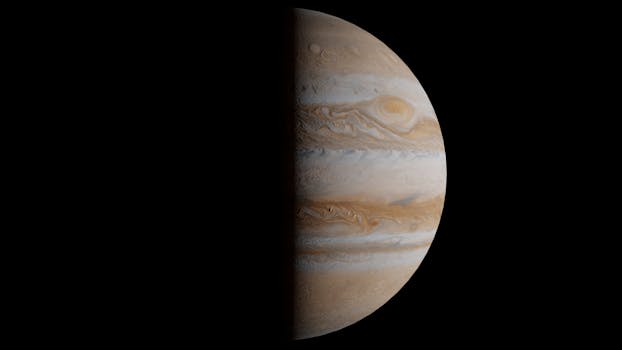
Jupiter, the behemoth of our solar system, is not only distinguished by its immense size but also by its expansive magnetosphere—the largest of any planet. This magnetic shield is so vast that, were it visible to us, it would appear multiple times larger than the full moon in our sky. Integral to shaping this magnetosphere are Jupiter’s moons, particularly the four largest known as the Galilean moons: Io, Europa, Ganymede, and Callisto.
The magnetosphere of Jupiter is a colossal, comet-shaped area teeming with charged particles held in place by the planet's magnetic field. These particles originate from the solar wind as well as from volcanic eruptions on Io, the innermost of the Galilean moons. The intricate interactions between these particles and the moons profoundly influence the structure and dynamics of the magnetosphere.
Io is exceptionally influential due to its status as the most volcanically active body in our solar system. Its powerful eruptions eject material, including sulfur dioxide gas, directly into space. Once ionized, this gas forms a plasma torus encircling Jupiter, interacting with its magnetic field to generate potent electric currents and intense radiation belts, which are vital components of the magnetosphere.
.png)
The other Galilean moons, Europa and Ganymede, impact the magnetosphere differently. Europa, encased in a thick ice shell, is believed to contain a subsurface ocean. This ocean’s interaction with Jupiter’s magnetic field could produce an additional magnetic field, thereby influencing the overall magnetospheric configuration. Ganymede stands out as it possesses its own intrinsic magnetic field, creating a mini-magnetosphere within Jupiter’s larger one. This unique feature leads to complex magnetic interactions that alter the movement of charged particles within the magnetosphere.
Callisto, orbiting furthest from Jupiter among the four, interacts less directly with the magnetosphere but still contributes significantly. It acts as a sink for high-energy particles, with its icy surface capturing and reflecting these particles, thereby playing a part in the broader radiation environment surrounding Jupiter.
These moon-magnetosphere interactions are not merely of academic interest but also have practical implications for space exploration. Understanding these dynamics is crucial for missions such as the Europa Clipper, helping scientists anticipate the radiation conditions that spacecraft will face when exploring Jupiter and its moons. This knowledge is vital for designing robust spacecraft capable of enduring the harsh Jovian environment.
Furthermore, studying Jupiter’s magnetosphere and its moons offers broader insights into magnetic fields of other celestial bodies, including exoplanets in far-flung solar systems. Insights gained from Jupiter can help scientists better understand how magnetic fields affect planetary environments, which is essential for assessing the habitability of planets beyond our own.
In summary, Jupiter’s moons are far more than simple satellites; they are dynamic, integral elements of the planet’s magnetosphere. Their interactions with the magnetic field not only sculpt the structure of the magnetosphere but also influence the entire Jovian system. As exploration of our solar system advances, the complex interplay between Jupiter and its moons continues to be a crucial area of research, providing deeper understanding of planetary systems throughout the universe.