Understanding Jupiter's Massive Magnetic Field
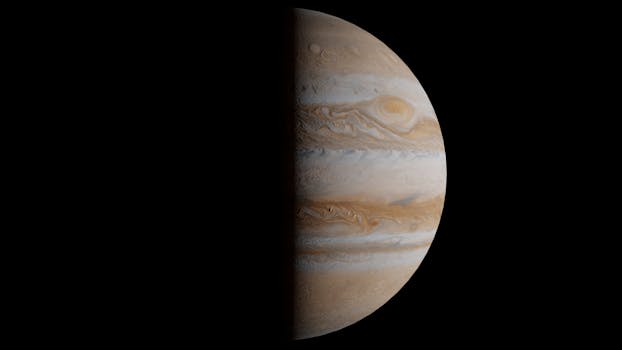
Jupiter, known for being the behemoth of our solar system, holds mysteries that extend beyond its swirling clouds and massive storms. One of its most compelling features is its colossal magnetic field, which not only dwarfs that of Earth but also presents a structure so complex that it continues to puzzle and fascinate scientists. This article explores the origins, characteristics, and impacts of Jupiter's magnetic field, providing insights into its role within our solar system and beyond.
Origin and Measurement
.png)
The source of Jupiter's magnetic field lies in its core, which comprises metallic hydrogen. Under the extreme pressures within Jupiter, hydrogen gas is compressed into a metallic state, capable of conducting electricity. Jupiter's rapid rotation, completing a turn on its axis approximately every 10 hours, drives electric currents through this metallic hydrogen, thereby generating a magnetic field that is much stronger than Earth's.
Initial measurements of Jupiter's magnetic field were made by the Pioneer 10 spacecraft in the early 1970s, marking a significant advancement in our understanding of the outer solar system. These measurements have been refined by subsequent missions, including the Voyager spacecraft and, more recently, NASA's Juno mission, which has been orbiting Jupiter since 2016. Juno's sophisticated instruments have allowed scientists to map the magnetic field with unprecedented detail, revealing its intricate and irregular nature.
Characteristics and Complexities
Juno's findings have shown that Jupiter's magnetic field is not a uniform or symmetric feature. Unlike the relatively simple dipolar magnetic field of Earth, Jupiter's field displays significant magnetic anomalies and irregular distributions of magnetic strength. These observations suggest that the dynamo generating Jupiter’s magnetic field operates closer to the planet's surface than previously thought, within a possibly turbulent layer of metallic hydrogen.
Implications and Influences
The strength and structure of Jupiter's magnetic field have profound implications for the planet's space environment. It traps and accelerates charged particles, creating radiation belts much more intense than Earth's Van Allen belts. These belts present major challenges for spacecraft, necessitating robust protective measures in the design of missions to Jupiter.
Moreover, the magnetic field interacts dynamically with Jupiter’s moons. For example, the interaction with Io, one of its moons, not only induces volcanic activity on Io due to tidal heating but also generates a torus of ionized particles around its orbit. This is just one instance of how Jupiter's magnetic environment influences its moons, impacting geological and atmospheric processes.
Broader Significance
Studying Jupiter's magnetic field also enriches our understanding of magnetic fields in other celestial contexts, including those of exoplanets. As we discover more about the variety and nature of exoplanetary systems, insights from Jupiter can help infer the magnetic conditions of planets outside our solar system, some of which may be candidates for hosting life.
Additionally, Jupiter’s magnetic field contributes to the structure of the solar system's heliosphere by influencing the solar wind. This interaction helps shield the inner planets from cosmic radiation and solar storms, subtly impacting the broader space weather system which affects Earth and other planets.
Conclusion
Jupiter’s magnetic field is a pivotal feature of our solar system, offering key insights into planetary science, magnetic field dynamics, and space weather. Ongoing research and future missions will continue to unravel the complexities of this giant planet’s magnetic field, enhancing our understanding of the universe's magnetic phenomena. As we delve deeper into the secrets of Jupiter, we not only uncover more about the planet itself but also about the fundamental processes that govern our solar system and beyond.