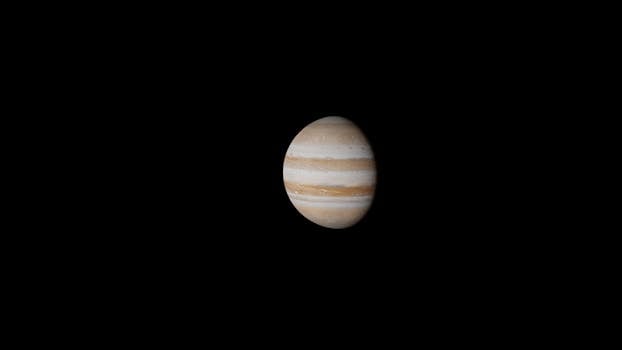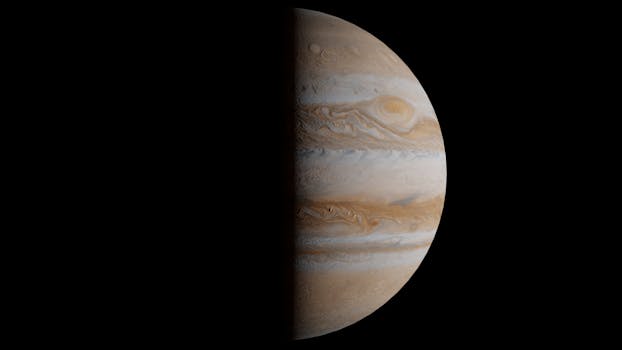
Jupiter, the behemoth of our solar system, serves as an extraordinary laboratory for atmospheric scientists. Its vast, turbulent atmosphere, dominated by hydrogen and helium, offers a stark contrast to Earth's and presents unique conditions ideal for studying atmospheric dynamics on a grand scale.
The Heat Beneath the Clouds
One of the most striking lessons from Jupiter relates to its heat and energy dynamics. Despite receiving less solar energy compared to Earth, Jupiter emits nearly twice as much heat. This excess heat, a product of the planet’s gradual contraction, plays a crucial role in driving its complex weather systems. The Great Red Spot, a storm larger than Earth itself and centuries old, is a prime example of these dynamics. Insights into how Jupiter's internal heat influences atmospheric phenomena can enhance our understanding of similar processes on Earth and other celestial bodies.
.png)
Winds of a Different World
Jupiter's wind systems also captivate scientists. With speeds reaching up to 360 kilometers per hour, these winds surpass those of any Earthly hurricane. Unlike Earth, where terrain and land formations significantly influence wind behavior, Jupiter’s lack of a solid surface allows for the unimpeded development of colossal wind systems. This comparison provides invaluable data on the fundamental physics of atmospheres, contributing to more accurate models on Earth and beyond.
Chemical Complexity in the Clouds
The chemical composition of Jupiter’s atmosphere is rich with elements like water, ammonia, and methane, setting the stage for reactions and cloud formations not observed on Earth. These processes offer clues into the atmospheric chemistry of other planets, potentially even those in distant solar systems. By understanding Jupiter's atmospheric chemistry, scientists can better hypothesize about the conditions that might support life elsewhere in the universe.
The Enigmatic Polar Cyclones
At Jupiter’s poles, the scene is dramatically different from anything on Earth. Numerous cyclones cluster in stable, geometric patterns, persisting far longer than similar phenomena on Earth. The persistence and arrangement of these cyclones challenge our understanding of meteorological stability and dynamics, providing a puzzle for scientists to decode.
Implications for Space Exploration and Beyond
Studying Jupiter’s atmosphere extends benefits beyond academic curiosity. For space exploration, it equips scientists with knowledge crucial for future missions to the gas giants of our solar system and for interpreting the atmospheric data from exoplanets. Understanding Jupiter's extreme weather also refines our models of atmospheric behavior under different conditions, which is vital for advanced predictive meteorology on Earth.
Conclusion
Jupiter's intricate and dynamic weather systems offer more than just a spectacle; they are a cornerstone for the field of atmospheric science. The insights gleaned from our giant neighbor aid in the continual improvement of how we understand and predict weather patterns on Earth, and they illuminate the conditions of distant worlds, potentially guiding future discoveries in our quest to find life beyond our solar system. Jupiter, with its mysterious depths and fierce winds, remains a key to unlocking the secrets of atmospheres near and far.