Jupiter: A Laboratory for Studying Giant Planets
The gas giant Jupiter, fifth planet from the Sun and the largest in our solar system, is far more than a spectacular object in the night sky. With its swirling storms, powerful magnetic field, and diverse collection of moons, Jupiter serves as a natural laboratory for astronomers and planetary scientists. By observing Jupiter and analyzing data from numerous missions, researchers gain unique insights not only into the workings of our solar system’s king but also into the formation, evolution, and nature of giant planets across the galaxy. In this article, we explore why Jupiter is considered an unparalleled laboratory, what we have learned from it so far, and how it helps us understand exoplanets—giant planets orbiting other stars.
Jupiter: The Archetype of Giant Planets
Jupiter’s status as the prototypical giant planet makes it a cornerstone for comparative planetology—the study of planets by comparing their characteristics. With a mass of 1.9 x 10^27 kilograms, Jupiter is more than 318 times as massive as Earth and contains over twice the mass of all other planets in the solar system combined. Its diameter of nearly 143,000 kilometers makes it 11 times wider than Earth.
What sets Jupiter apart as a laboratory is the fact that it is primarily composed of hydrogen (about 90% by volume) and helium (almost 10%), closely mirroring the composition of the Sun and the primordial solar nebula from which the solar system formed. Unlike terrestrial planets, Jupiter never underwent the same extensive differentiation into core, mantle, and crust. Instead, it preserves conditions akin to those present in the early solar system.
.png)
This makes Jupiter an ideal subject for understanding the processes that lead to planet formation, atmospheric dynamics, and the behavior of matter under extreme pressure and temperature. The planet’s rapid rotation (a day on Jupiter lasts only about 9.9 hours) and strong internal heat further contribute to its unique and complex atmospheric phenomena.
Atmospheric Dynamics: A Showcase of Extreme Weather
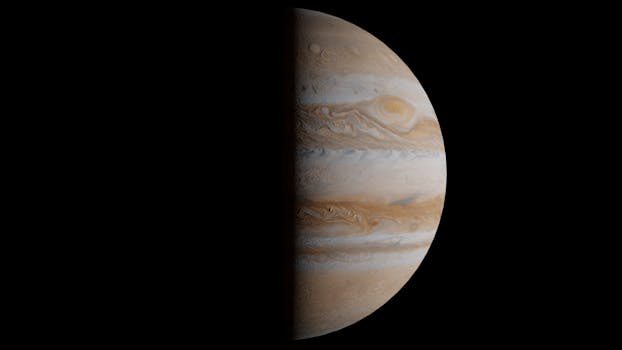
Jupiter’s atmosphere is a dynamic stage for some of the most powerful weather phenomena in the solar system. The famous Great Red Spot—a giant storm larger than Earth—has raged for at least 350 years, providing scientists with a rare opportunity to study persistent atmospheric vortices.
Jupiter’s atmosphere is divided into bands of clouds, called zones (lighter) and belts (darker), which move at different speeds and directions. Winds in these bands can reach speeds of up to 650 kilometers per hour, far surpassing the fastest hurricanes on Earth. The Voyager spacecraft first revealed the complexity of these bands in the late 1970s, and subsequent observations from the Hubble Space Telescope and the Juno mission have provided high-resolution images of their turbulent interactions.
One of Jupiter’s most intriguing features is its colorful cloud composition. The upper clouds are mainly composed of ammonia crystals, while deeper layers may contain ammonium hydrosulfide and water. The vibrant hues—ranging from white and yellow to red and brown—are thought to result from trace chemicals that react under ultraviolet sunlight.
Studying Jupiter’s weather systems helps researchers develop models for gas giant atmospheres, which can be applied to similar planets observed around other stars. For example, the detection of hot Jupiters—giant exoplanets orbiting close to their stars—has prompted scientists to compare their atmospheric dynamics to those of Jupiter, using the gas giant as a benchmark.
Internal Structure and Magnetic Field: Probing the Depths
Jupiter’s immense mass and composition allow for states of matter and physical conditions not found on Earth. Deep within the planet, pressures exceed 40 million bars (about 40 million times Earth’s atmospheric pressure at sea level), causing hydrogen to exist in a metallic state. This metallic hydrogen is highly conductive and is believed to generate Jupiter’s powerful magnetic field, which is the strongest of any planet in the solar system—about 20,000 times stronger than Earth’s.
Understanding Jupiter’s internal structure has been a major goal of the Juno mission, launched by NASA in 2011 and orbiting Jupiter since 2016. Juno’s gravity measurements suggest that Jupiter may have a diffuse, “fuzzy” core rather than a distinct solid one. This finding challenges earlier models and has implications for theories of giant planet formation.
Jupiter’s magnetic field also produces spectacular phenomena such as intense radiation belts and auroras at its poles. These auroras are some of the brightest in the solar system and are powered not only by the solar wind but also by interactions with the planet’s moons, especially Io. The study of Jupiter’s magnetosphere provides a template for understanding the magnetic environments of exoplanets, particularly those orbiting close to their stars where magnetic interactions can be intense.
Jupiter’s Moons: A System Within a System
Jupiter’s gravitational influence extends far beyond the planet itself, shaping a mini-system of more than 95 known moons as of 2024. Four of these—the Galilean moons Io, Europa, Ganymede, and Callisto—are among the largest moons in the solar system and display remarkable geological diversity.
Io is the most volcanically active body in the solar system, with over 400 active volcanoes. Europa is of great interest for its subsurface ocean, which may harbor conditions suitable for life. Ganymede, the largest moon in the solar system, is the only moon known to have its own global magnetic field. Callisto, heavily cratered and ancient, preserves a record of the early solar system.
The diversity of Jupiter’s moons provides a unique opportunity to study planetary processes such as tidal heating, differentiation, and surface chemistry. By comparing these moons, scientists can test theories about the evolution of planetary systems and the potential habitability of icy worlds.
Jupiter as a Proxy for Exoplanet Studies
The discovery of thousands of exoplanets—planets orbiting stars outside our solar system—has revolutionized our understanding of planetary systems. Many of these exoplanets are gas giants, some even larger than Jupiter, and are found in a variety of orbits.
Jupiter’s well-studied characteristics make it a critical reference point for interpreting exoplanet observations. For example, the atmospheric composition of Jupiter—rich in hydrogen and helium, with trace amounts of methane, ammonia, and water—provides a baseline for analyzing the spectra of exoplanet atmospheres. The study of Jupiter’s cloud dynamics, heat emission, and auroral activity informs models used to predict the weather and climate on distant worlds.
A comparison of Jupiter and typical exoplanet giants is shown below:
| Feature | Jupiter | Typical Hot Jupiter Exoplanet |
|---|---|---|
| Mass | 1 Jupiter mass (1.90 x 10^27 kg) | 0.5–3 Jupiter masses |
| Orbital Distance | 5.2 AU from Sun | 0.01–0.1 AU from star |
| Atmospheric Composition | Hydrogen, helium, methane, ammonia, water | Similar, but often with additional exotic molecules due to high temperatures |
| Temperature (Cloud Tops) | -145°C (128 K) | 1000–2500°C |
| Magnetic Field | ~20,000 times Earth's | Unknown, but likely strong |
Observations of “hot Jupiters” have revealed phenomena not present in our Jupiter, such as atmospheric escape and extreme temperature gradients. Nonetheless, the fundamental physics remains comparable, making Jupiter an invaluable guide for interpreting these distant worlds.
The Role of Space Missions: Expanding Our Understanding
Missions to Jupiter have been pivotal in transforming the planet from a blurry point of light into a rich field of scientific inquiry. Pioneering flybys by the Pioneer and Voyager spacecraft in the 1970s provided the first close-up images and measurements. The Galileo orbiter (1995–2003) delivered a wealth of information about Jupiter’s atmosphere and moons, even releasing a probe that entered Jupiter’s clouds and survived for 58 minutes, measuring wind speeds up to 530 km/h.
Juno, currently in orbit, continues to map the planet’s gravity, magnetic field, and atmospheric dynamics with unprecedented detail. The European Space Agency’s Jupiter Icy Moons Explorer (JUICE), launched in 2023, is set to explore Jupiter’s environment and its largest moons, particularly Ganymede, in the early 2030s.
Each mission yields new data, sometimes upending previous theories. For instance, Juno’s discovery of ammonia “weather” and deep atmospheric jets has forced a rethink of gas giant meteorology. These missions not only deepen our understanding of Jupiter but also improve our models of giant planets universally.
Conclusion: Jupiter’s Role in Planetary Science
Jupiter’s immense size, complex atmosphere, powerful magnetic field, and diverse family of moons make it the ultimate laboratory for studying giant planet science. Its influence stretches from the early formation of the solar system to the cutting-edge search for exoplanets. Every new discovery at Jupiter reshapes our understanding of how planets form, evolve, and interact with their environments—both in our solar system and in countless planetary systems across the galaxy.
As new missions continue to probe its mysteries, Jupiter stands as a reminder of the dynamic, interconnected processes that govern planets large and small. For scientists and the public alike, Jupiter is not just a giant—it is a gateway to understanding the cosmos.