Jupiter, the largest planet in our solar system, has always captivated both astronomers and space enthusiasts with its massive size and visually striking atmosphere. What makes Jupiter even more intriguing is that its atmosphere serves as a window into both the planet's nature and the broader processes that have shaped our solar system since its inception.
Primary Composition
The atmosphere of Jupiter is predominantly made up of hydrogen and helium, similar to the sun. Specifically, hydrogen constitutes roughly 90% of the atmosphere, while helium accounts for about 10%. This composition mirrors that of the primordial solar nebula from which the solar system was formed, indicating that Jupiter has retained much of its original gaseous envelope.
.png)
Trace Elements and Visual Features
Beyond hydrogen and helium, the Jovian atmosphere contains small amounts of other gases, including methane, ammonia, hydrogen sulfide, and water vapor. These trace gases are crucial for the planet's complex weather systems and its colorful appearance.
- Methane: This gas absorbs red light and reflects blue light, lending a blue tint to areas of the atmosphere rich in methane.
- Ammonia: By absorbing blue light, ammonia enhances the red and orange hues observable in Jupiter's atmosphere.
- Water Vapor and Hydrogen Sulfide: These gases contribute to the formation of clouds and precipitation within the planet's atmosphere, influencing weather patterns.
Atmospheric Structure and Dynamics
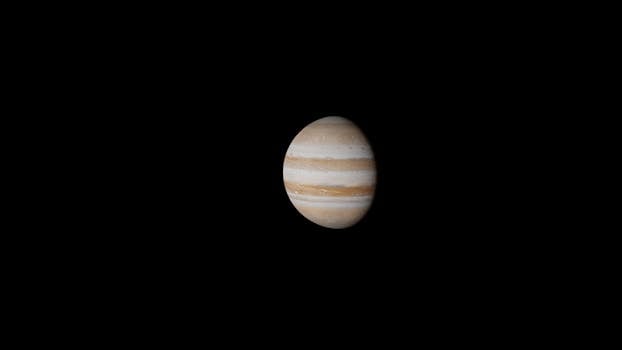
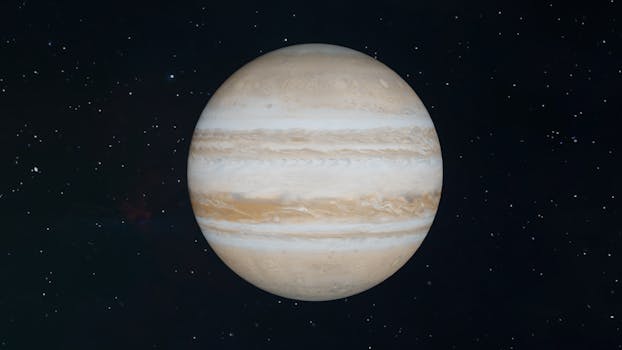
Jupiter's atmosphere is layered with clouds composed of ammonia, ammonium hydrosulfide, and water, arranged in bands of different temperatures and compositions. These bands are visible from space as distinct, colorful stripes encircling the planet. The fast rotation of Jupiter (a full rotation occurs every 10 hours) generates strong jet streams that further segment these bands into darker belts and lighter zones, correlating with descending and rising gases, respectively.
Notable Atmospheric Features
Among the most famous features in Jupiter's atmosphere is the Great Red Spot, a gigantic storm larger than Earth that has been ongoing for at least 400 years. This storm is a testament to the dynamic and turbulent nature of Jupiter's weather, driven by internal heat and rapid rotation.
Scientific Exploration and Studies
The exploration of Jupiter's atmosphere has been significantly advanced by missions such as the Galileo probe, which directly entered Jupiter's atmosphere in 1995, and the ongoing Juno mission, which has been orbiting the planet since 2016. These missions have provided invaluable data on the atmospheric conditions, chemical composition, and magnetic fields.
Broader Implications
Studying Jupiter's atmosphere not only enhances our understanding of the giant planet but also offers insights into planetary atmospheres in general, including Earth's. Comparisons between different planetary atmospheres help scientists deduce the key processes affecting atmospheric dynamics across the solar system.
Additionally, Jupiter's atmosphere serves as a comparative basis for the study of exoplanets, many of which are gas giants. Insights gained from Jupiter can aid in assessing the habitability of other worlds and the potential for extraterrestrial life.
Conclusion
Jupiter's atmosphere is a rich tapestry of gases, weather systems, and chemical interactions, making it a focal point for scientific study. The ongoing exploration of Jupiter not only broadens our understanding of the giant planet but also enriches our knowledge of planetary science and the conditions that may exist on distant worlds. As our technological and exploratory capabilities evolve, so too will our insights into Jupiter's atmosphere and what it can teach us about the cosmos.