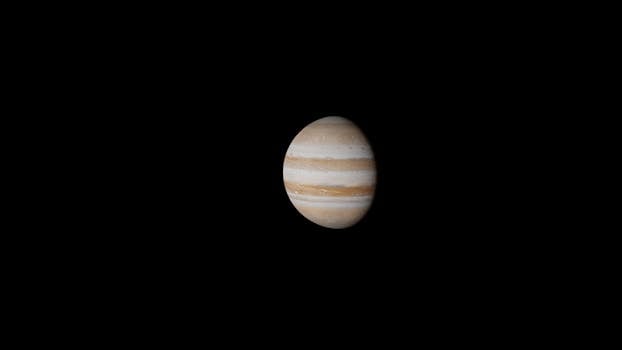
Jupiter, the largest planet in our solar system, has always fascinated astronomers and space enthusiasts alike. Its massive size and prominent bands of swirling clouds offer a glimpse into the complex atmospheric dynamics of a gas giant. In this article, we will delve deeper into the characteristics and components of Jupiter's atmosphere, exploring what makes it so unique and dynamic.
Jupiter's atmosphere is primarily composed of hydrogen and helium, similar to the sun. This composition reflects the planet's formation from the primordial solar nebula. The atmosphere contains trace amounts of methane, water vapor, ammonia, and silicon-based compounds, which contribute to its varied weather patterns and the iconic Great Red Spot.
One of the most striking features of Jupiter's atmosphere is its layered cloud structure. The clouds are arranged in bands of different colors, including white, red, orange, and brown. These colors result from the different temperatures and chemical compositions of the cloud layers. The lighter-colored zones are cooler and consist of ammonia ice, while the darker belts are warmer and made up of deeper clouds containing complex organic compounds.
.png)
The Great Red Spot, a giant storm larger than Earth, is perhaps the most well-known feature of Jupiter's atmosphere. This anticyclonic storm has been raging for at least 350 years, and its longevity is due to Jupiter's lack of a solid surface, which allows for minimal frictional forces to dissipate the storm. The storm's reddish hue comes from the presence of phosphorus-containing molecules, though the exact chemical composition remains a topic of research.
Jupiter's atmosphere doesn't just consist of static layers; it is incredibly dynamic. The planet's rapid rotation, completing one spin in just under 10 hours, creates strong jet streams that can reach speeds of up to 400 kilometers per hour. These jet streams help to organize the clouds into the banded structure observed from space.
In addition to the horizontal movements, there are also vertical movements within the atmosphere. These are driven by internal heat escaping from the planet's core. Jupiter radiates more heat than it receives from the Sun, indicating that it has its own internal heat source. This heat causes the atmosphere to convect, similar to a boiling pot of water, leading to the formation of storms and turbulence.
The study of Jupiter's atmosphere provides valuable insights into the atmospheric dynamics of other gas giants in our solar system and beyond. For instance, understanding Jupiter's weather patterns helps scientists model the atmospheres of exoplanets, particularly those that are gas giants like Jupiter.
Moreover, missions like NASA's Juno spacecraft, which has been orbiting Jupiter since 2016, have provided unprecedented data about the planet's atmosphere, magnetic field, and interior. Juno's findings have revealed intricate details about the atmospheric pressures, temperatures, and compositions at different depths, offering clues about the planet's formation and evolution.
In conclusion, Jupiter's atmosphere is a vibrant and complex system characterized by its chemical diversity, dynamic weather patterns, and iconic storms. Its study not only satisfies human curiosity about our solar system's giant but also enhances our understanding of planetary atmospheres in a broader cosmic context. As technology and scientific methods continue to advance, we can expect to uncover even more secrets about this fascinating giant planet.