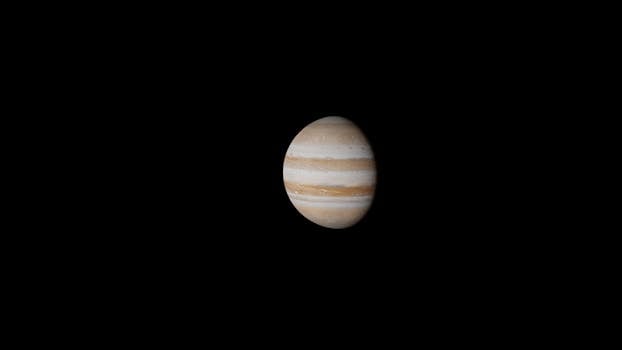
Jupiter, the behemoth of our solar system, not only captivates with its sheer magnitude but also perplexes astronomers with its complex atmospheric phenomena. In this exploration, we delve into the various mysteries of Jupiter's atmosphere, the methods by which scientists study this gas giant, and the broader implications of their discoveries.
Understanding Jupiter’s Atmosphere
At its core, Jupiter is a swirling concoction of hydrogen and helium, but it's the traces of ammonia, methane, and water vapor that spice up its atmosphere, leading to dynamic weather systems and phenomena like the iconic Great Red Spot. This giant planet is veiled by deep, vibrant cloud bands and is home to colossal storms and fierce winds that can whip up to speeds of 620 kilometers per hour.
.png)
Approaches to Studying Jupiter’s Atmosphere
The study of Jupiter combines observational techniques from Earth, direct data from spacecraft, and sophisticated theoretical models:
- Spacecraft Missions: Instruments like NASA’s Juno spacecraft, orbiting Jupiter since 2016, offer unrivaled close-up data on the planet’s atmosphere, magnetic fields, and internal structure. Juno's intimate observations shed light on aspects of Jupiter that are invisible to Earth-based instruments.
- Ground-Based Telescopes: Despite the distance, Earth-based telescopes remain invaluable for ongoing monitoring of Jupiter. The Hubble Space Telescope, among others, provides high-resolution imagery that allows scientists to track atmospheric changes and study weather patterns over extended periods.
- Theoretical Models: Simulation models are indispensable for interpreting Jupiter’s atmospheric dynamics. These models utilize data from telescopic observations and spacecraft to forecast weather patterns, analyze atmospheric chemistry, and predict storm behaviors.
Comparing the Advantages and Disadvantages
Each method has its strengths and weaknesses:
- Spacecraft Missions: These missions deliver precise data but come with high costs and significant risk of failure. The extensive planning and execution time also add to their complexity.
- Ground-Based Telescopes: While more economical and accessible than space missions, their effectiveness is often hampered by Earth’s atmospheric interference, which can blur images and skew data.
- Theoretical Models: Models are excellent for making predictions but rely heavily on the accuracy of the input data. Incorrect assumptions or flawed data can lead to erroneous conclusions.
Practical Examples
The data from the Juno mission has dramatically enhanced our understanding of Jupiter’s atmosphere. Discoveries about the depth and structure of the Great Red Spot, for instance, offer insights into the atmospheric dynamics and energy systems at play, which are crucial for understanding both Jupiter and atmospheric science more broadly.
Conclusion
The investigation of Jupiter’s atmosphere is a multifaceted scientific challenge that spans various disciplines and technologies. Each approach provides unique insights but also presents specific challenges. Ongoing research and future missions will be critical in unraveling the remaining mysteries of Jupiter’s atmosphere and advancing our knowledge of planetary atmospheres as a whole. As our understanding deepens, it not only quenches our curiosity but also enhances our ability to model and predict weather on other planets, including Earth. The continued exploration of Jupiter stands as a testament to humanity's relentless pursuit of knowledge and our desire to understand the cosmos.