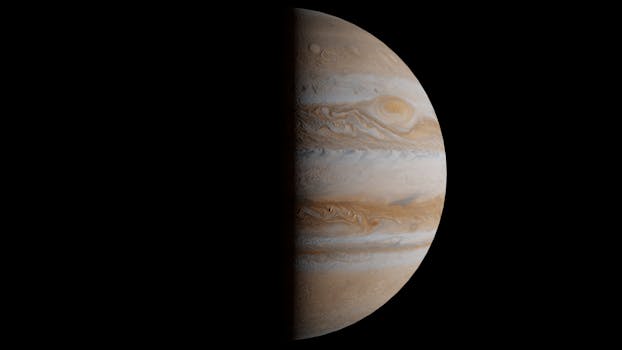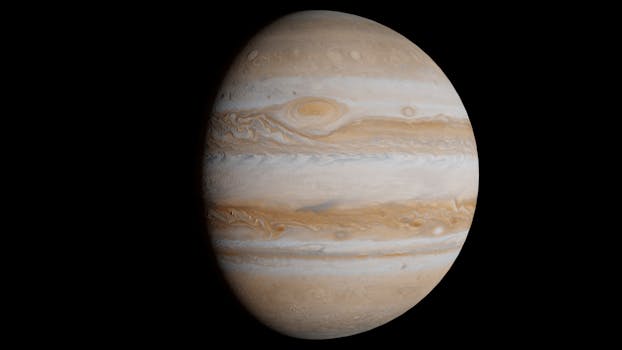
Jupiter, the behemoth of our solar system, has always been at the center of astronomical studies, not only because of its massive size and complex atmospheric phenomena but also due to its intriguing array of moons. With a staggering count of 79 confirmed moons, each presents its own set of mysteries and scientific opportunities. Particularly, the four largest - Io, Europa, Ganymede, and Callisto, known as the Galilean moons, continue to be the focus of intense research and speculation, especially about extraterrestrial life and solar system formation.
Io: The Volcanic Powerhouse
Io stands out due to its extreme geological activity. It is the most volcanically active body in the solar system, with hundreds of volcanoes, some ejecting plumes into space. This moon is an excellent laboratory for studying tidal heating, which is caused by the intense gravitational pull from Jupiter, as well as by Io's orbital resonance with Europa and Ganymede. The energy from these interactions heats Io's interior, causing sulfur and sulfur dioxide eruptions. Understanding Io's volcanic nature can provide insights into geological processes that are likely unique in the solar system.
.png)
Europa: Searching for Subsurface Oceans
Europa's icy surface and the possibility of a subsurface ocean make it a prime candidate for the search for extraterrestrial life. The moon's ice shell covers what scientists believe could be a global ocean containing twice the water of all Earth's oceans combined. The smooth, fractured surface suggests a dynamic environment beneath. With missions like the upcoming Europa Clipper, set to launch in the 2020s, scientists hope to delve deeper into these mysteries, exploring potential habitats and analyzing the icy surface for signs of subsurface activity.
Ganymede: A Moon with Its Own Magnetic Field
Ganymede is not only the largest moon in the solar system but also remarkable for having its own magnetic field, possibly generated by a liquid iron or iron-sulfide core. The surface of Ganymede is a tapestry of dark, heavily cratered regions and lighter, grooved terrains, indicating a complex geological history. Studying Ganymede helps scientists understand the magnetic and structural properties of celestial bodies, offering a clearer picture of how similar magnetic fields might occur on other moons or planets.
Callisto: The Ancient Impact Recorder
Callisto, the outermost Galilean moon, presents a heavily cratered landscape, appearing as a celestial body that has remained largely unchanged for billions of years. This makes Callisto a valuable time capsule for researchers, providing insights into the early solar system's conditions and the prevalence and effects of impacts over time. Its cratered, icy landscape is ideal for studying the natural history of our solar system and the processes that have shaped planetary bodies.
Broader Implications for Space Exploration
The study of Jupiter’s moons extends beyond academic interest. Understanding these moons' conditions, particularly Europa’s potential for harboring life, could inform future missions targeting life elsewhere in the cosmos. These moons also serve as analogs for icy bodies in the outer solar system, aiding our understanding of other potentially habitable worlds.
Conclusion: Gateways to Cosmic Discoveries
Jupiter’s moons are much more than mere satellites; they are dynamic worlds that offer answers to fundamental questions about our solar system. As we continue to advance technologically and expand our exploratory reach, the secrets of these moons will gradually unravel, providing us not only with insights into other worlds but also into the possibilities of life and the origins of the solar system itself. The exploration of Jupiter’s moons is not just a journey to distant celestial bodies but a quest into the broader mysteries of the universe.