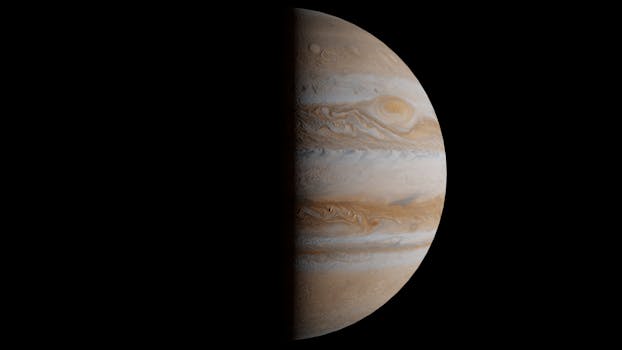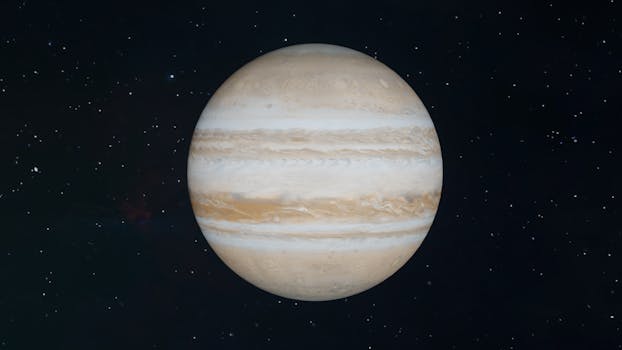
Jupiter, with its immense size and magnetic field, not only dominates our solar system but also hosts a collection of moons that are themselves fascinating worlds. Among these, Europa, Ganymede, and Callisto stand out due to their potential to support life. This article explores the environments of these moons, the technological efforts to study them, and the prospects of discovering life in these alien oceans.
Understanding the Moons' Environments
Each of Jupiter's relevant moons offers distinct characteristics that make them interesting to researchers:
.png)
- Europa: It is characterized by a smooth, icy surface beneath which lies an ocean of saltwater. This makes Europa one of the prime candidates for hosting life, as its ocean is believed to contain twice as much water as Earth's oceans.
- Ganymede: Not only is it the largest moon in the solar system, but it also boasts its own magnetic field, which is unique among moons. Beneath its icy crust, Ganymede harbors a deep ocean, adding another layer of intrigue for scientists searching for life.
- Callisto: With a heavily cratered ice surface, Callisto presents a more rugged and ancient terrain. It also likely contains an underground ocean, though it is considered less active geologically and potentially less hospitable than Europa or Ganymede.
Technological Approaches to Exploration
The exploration of these icy moons requires cutting-edge technology. Key missions include:
- NASA's Europa Clipper: Slated for a launch in the 2020s, this spacecraft will orbit Jupiter and conduct detailed reconnaissance of Europa's ice shell and ocean by using radar to penetrate the ice and analyze its thickness and salinity.
- ESA's JUICE: The JUpiter ICy moons Explorer aims to spend at least three years making detailed observations of Jupiter and three of its largest moons, with a focus on Ganymede. It will be the first spacecraft to orbit a moon other than Earth's Moon.
Comparing the Moons' Potential for Life
While each moon presents possibilities, they have pros and cons regarding habitability:
- Europa: Its thick ice shell provides protection from Jupiter's radiation, making its subsurface ocean a likely place for life. However, the ice shell also poses a significant barrier to direct observation and sampling of the ocean.
- Ganymede: The presence of a magnetic field offers some protection from Jupiter’s radiation, similar to Europa. Additionally, its intrinsic magnetic field might support a tenuous atmosphere, possibly consisting of oxygen, though likely too thin to support human life.
- Callisto: Its surface is the most accessible, as it is less geologically active and has no significant atmosphere or magnetic field to complicate landing missions. However, this also means it is more exposed to cosmic radiation, potentially reducing habitability.
Practical Examples of Astrobiological Studies
On Earth, the study of extremophiles—organisms that survive in extreme conditions—provides insights into what types of life forms might exist on these moons. For example, organisms in Earth's hydrothermal vents thrive without sunlight, using chemosynthesis instead of photosynthesis, hinting at similar possibilities in the subsurface oceans of Europa or Ganymede.
Conclusion: The Future of Exploration
The study of Jupiter's moons is more than a quest for knowledge; it's a search for life beyond Earth. With advanced missions like Europa Clipper and JUICE on the horizon, our understanding of these distant worlds will undoubtedly expand. As these missions provide new data and insights, they may also bring us closer to answering the profound question of whether we are alone in the universe, making Jupiter’s moons not just points of light in our telescopes, but possible habitats for life.