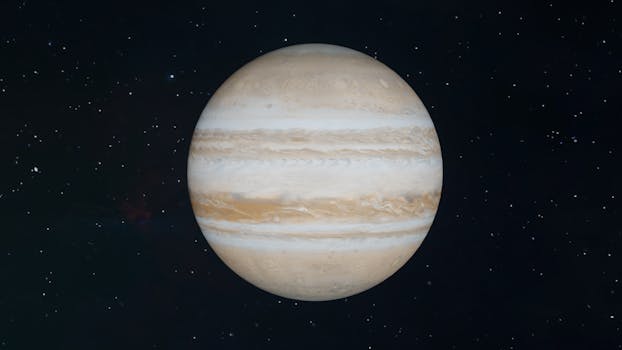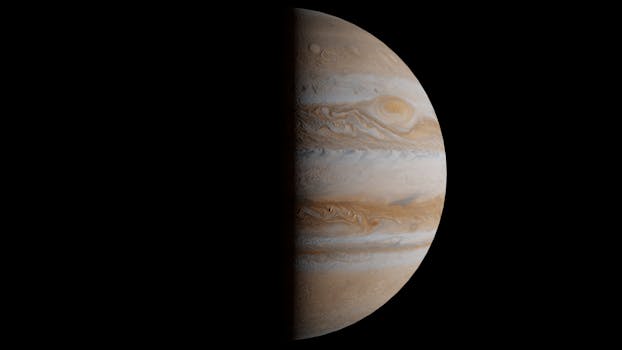
Jupiter, renowned as the behemoth of our solar system, is not only known for its majestic size and striking features but also for its fascinating entourage of moons. While the Galilean moons—Io, Europa, Ganymede, and Callisto—are often spotlighted for their unique characteristics and potential for harboring life, Jupiter's lesser-known moons present a treasure trove of scientific data and mysteries. These smaller moons, numbering 79 in total, offer insights into the early solar system's dynamics and Jupiter’s formation and evolution.
Amalthea: Jupiter's Reddened Moon
Among these lesser-known satellites, Amalthea stands out. Discovered in 1892, it is the largest of Jupiter's inner moons and is notable for its irregular shape and distinct red color, which scientists speculate may be due to sulfur spewed from Io or perhaps from organic compounds. Positioned very close to Jupiter, Amalthea faces extreme radiation and significant gravitational forces. These conditions provide scientists with data about the moon's internal structure and composition, which are crucial for understanding the impacts of such extreme environmental factors on celestial bodies.
.png)
Thebe: Enigmatic and Dusty
Thebe, discovered by the Voyager 1 spacecraft in 1979, orbits between Amalthea and Io. Like Amalthea, Thebe is irregularly shaped and has an orbit littered with dust, contributing to one of Jupiter’s faint rings. Its unique position and characteristics offer valuable clues about the natural processes that influenced the early solar system's architecture.
Himalia: The Captured Asteroid
Moving outward, the moon Himalia, the largest of the so-called Himalia group, presents a fascinating case. It is believed to be either a captured asteroid or a remnant of a larger celestial body that shattered. Himalia's irregular and elongated shape and its non-synchronous rotation hint at a tumultuous past involving violent collisions and captures, providing a glimpse into the chaotic early days of our solar system.
Carme: A Fragmented History
The Carme group, consisting of moons that are believed to be fragments of a once larger moon destroyed by an impact, orbits Jupiter in a retrograde direction, opposite to the planet’s rotation. This unusual characteristic strongly supports the theory that these moons were captured by Jupiter’s gravity. Carme, the largest among them, features a dark surface possibly indicating a primitive, carbon-rich composition.
Ananke: Tracing Back to Asteroids
Similarly, the Ananke group, named after its largest moon Ananke, consists of retrograde moons likely formed from collision fragments. Believed to be a captured asteroid, Ananke and its fellow group members offer a microcosm for studying gravitational interactions and the evolutionary dynamics within the Jovian system.
Scientific and Exploratory Significance
The study of these lesser-known moons is invaluable for several reasons. They not only provide a historical record of the early solar system but also are critical for planning future missions to Jupiter. Understanding the orbital paths, composition, and environmental conditions of these moons aids in designing missions that mitigate risks and optimize scientific returns. For instance, the harsh radiation environment around moons like Amalthea and Thebe must be considered when designing spacecraft.
Furthermore, insights gained from Jupiter’s moons help enhance our understanding of planetary systems beyond our own. The processes observed around Jupiter may offer analogs for the mechanisms at play around other stars, contributing to our knowledge of exoplanets and their moons across the galaxy.
Conclusion
In conclusion, while Jupiter's Galilean moons often capture public and scientific interest, the lesser-known moons, with their rich histories and complex characteristics, are equally deserving of attention. From Amalthea to Ananke, each moon holds keys to understanding not just the Jovian system but also the broader cosmic phenomena shaping our universe. As explorations continue, each discovery peels back another layer of the vast and mysterious outer space, bringing us closer to answering fundamental questions about our place in the cosmos.