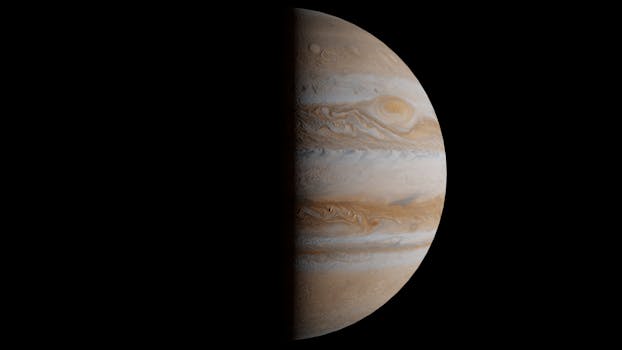
Jupiter, often referred to as the behemoth of our solar system, plays a crucial role in the field of astrobiology, the interdisciplinary science that seeks to understand the potential for life beyond Earth. Despite being a gas giant with hostile conditions unsuitable for life as we know it, Jupiter's influence and its diverse system of moons are of significant interest to scientists exploring the conditions necessary for life elsewhere in the universe.
The Astrobiological Significance of Jupiter's Moons
The interest in Jupiter from an astrobiological perspective largely centers on its moons, particularly Europa, Ganymede, and Callisto. These moons are considered prime candidates in the search for extraterrestrial life due to their potential subsurface oceans.
.png)
Europa is one of the most promising bodies in our solar system when it comes to the search for life. Shielded beneath a thick crust of ice, Europa is believed to house a saline ocean that contains more water than all of Earth's oceans combined. This, coupled with the potential for hydrothermal vents on its ocean floor, similar to those on Earth where life thrives, makes Europa a prime candidate for harboring life. NASA's planned Europa Clipper mission is set to launch in the 2020s to probe this intriguing moon further, assessing its habitability and searching for signs of life.
Ganymede, the largest moon in the solar system, not only has a water ocean but also possesses a thin oxygen atmosphere and its own magnetic field. This magnetic field could shield life forms from Jupiter’s fierce radiation, providing a stable environment similar to Earth's protective geomagnetic shield. The upcoming JUICE (JUpiter ICy moons Explorer) mission by the European Space Agency is specifically designed to study Ganymede, along with Europa and Callisto, further exploring their potential to support life.
Callisto offers a different kind of environment. With a surface that is heavily cratered and ancient, Callisto shows signs of a long, stable geological history. It is less affected by Jupiter's radiation compared to its neighboring moons, which makes it another interesting candidate for hosting a subsurface ocean.
Jupiter's Influence on Solar System Dynamics
Jupiter's role in astrobiology also extends to its gravitational influence on the solar system. Its massive size and strong gravitational pull have had a profound impact on the arrangement and safety of other planetary bodies. Jupiter captures and redirects comets and asteroids that might otherwise threaten Earth and other inner planets. By acting as a cosmic shield, Jupiter plays a protective role, potentially enabling life to thrive on our planet by reducing the frequency of catastrophic impacts.
Contribution to Planetary Science and Astrobiology
Studying Jupiter's atmospheric dynamics and magnetic environment also offers valuable insights into planetary science. This giant planet features extreme atmospheric conditions, including powerful winds and massive storms such as the Great Red Spot. Understanding these phenomena can provide clues about atmospheric dynamics in a range of planetary environments, including those that might support life.
Conclusion
While Jupiter itself is not a candidate for life, its astrobiological importance cannot be overstated. Its moons present some of the most promising environments for life beyond Earth, and studying them could unravel the mysteries of life's potential elsewhere in the cosmos. Furthermore, Jupiter's protective influence and role in planetary dynamics contribute to the broader understanding of how life-supporting environments are created and sustained. As space exploration continues to advance, Jupiter and its moons will remain key subjects in the ongoing search for extraterrestrial life, offering insights not only about our solar system but also about the conditions that might support life across the universe.