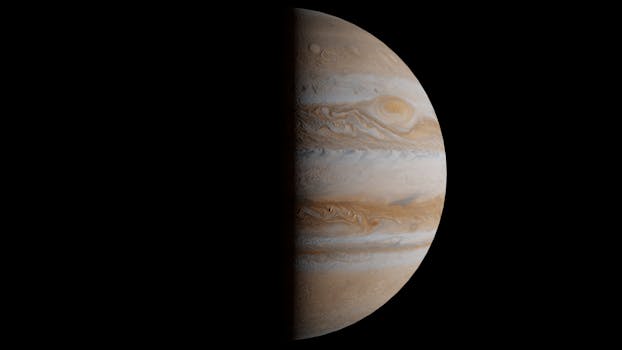
Jupiter, the colossal giant of our solar system, is renowned not only for its massive size and striking gas bands but also for its impressive entourage of moons. While the Galilean moons—Io, Europa, Ganymede, and Callisto—often steal the limelight due to their large sizes and unique geological features, Jupiter's lesser-known moons present a fascinating array of mysteries and scientific opportunities of their own. With a total of 79 confirmed moons, Jupiter's lesser-known satellites offer a unique glimpse into the solar system's dynamic processes and the history of planetary formation.
Amalthea: The Red Moon Amalthea, discovered in 1892 by Edward Emerson Barnard, stands out as the largest among Jupiter's inner moons. This irregularly shaped moon measures approximately 250 x 146 x 128 kilometers. Orbiting at a mere 181,000 kilometers from Jupiter, Amalthea is crucial for understanding the inner workings of the Jovian system. Its surface is a mix of rock and ice, heavily cratered and streaked with deposits of bright material, possibly icy debris from its interior. Amalthea's close proximity to Jupiter also makes it significant for maintaining the stability of Jupiter's faint ring system, acting as a shepherd moon.
Himalia: The Captured Asteroid Venturing further from Jupiter, we encounter Himalia, the largest of the Himalia group—a collection of moons that likely share a common origin, possibly as a captured asteroid from the asteroid belt. Himalia, about 150 kilometers in diameter, orbits Jupiter at about 11.5 million kilometers. Its characteristics are similar to C-type asteroids, suggesting a composition rich in carbonaceous material. The study of Himalia can provide insights into how Jupiter’s gravitational might interacts with passing asteroids, pulling them into orbit as moons.
.png)
Elara: A Mysterious Giant Elara, another member of the Himalia group, was discovered in 1905 by Charles Dillon Perrine. Despite being one of the larger moons in this group with a diameter of about 80 kilometers, little is known about its composition or specific surface features due to the lack of close-range observations by spacecraft. Like Himalia, Elara’s characteristics suggest it could be a captured asteroid, offering another piece in the puzzle of Jupiter's gravitational influence and the history of solar system formation.
Pasiphae: Tracing Retrograde Orbits Among the outer moons, Pasiphae captivates interest due to its retrograde orbit, meaning it moves in the opposite direction to Jupiter’s rotation. This moon, approximately 60 kilometers in diameter, orbits at a staggering distance of over 23 million kilometers from Jupiter. Its retrograde motion and composition hint at a possible origin as a D-type asteroid, providing clues to the early dynamical processes of our solar system and how moons are captured into retrograde orbits.
Thebe: Guardian of the Gossamer Ring Thebe, discovered by Voyager 1 in 1979, orbits just outside Amalthea and is about 100 kilometers across. This moon is significant for its geological activity, evidenced by a heavily cratered surface littered with a large amount of dust and debris—byproducts of numerous impacts. Thebe is particularly notable for its contribution to Jupiter's Gossamer ring, believed to be sourced from material ejected from its surface.
These lesser-known moons of Jupiter are more than just celestial bodies orbiting the giant planet; they are keys to understanding the complex gravitational interactions and evolutionary history of our solar system. Each moon, with its unique orbit, composition, and history, offers valuable insights and enriches our understanding of planetary science.
As future missions and telescopes continue to explore these distant worlds, we can expect to uncover further secrets and deepen our knowledge of not only Jupiter’s moon system but also of the broader mechanisms governing our solar system. While the Galilean moons may capture the most attention, Jupiter’s smaller and lesser-known moons are proving to be just as critical to our scientific knowledge and curiosity.