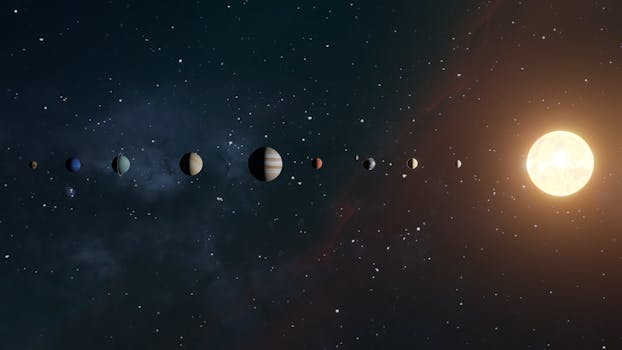
Jupiter: The Colossal Guardian of Our Solar System
Jupiter, often celebrated as the "King of Planets," is a giant among its peers in our solar system, both in size and influence. As the largest planet, Jupiter's presence and characteristics offer key insights into the history and mechanics of our cosmic neighborhood. Its sheer size and dynamic atmosphere make it an object of continuous fascination and study.
Characteristics and Composition
.png)
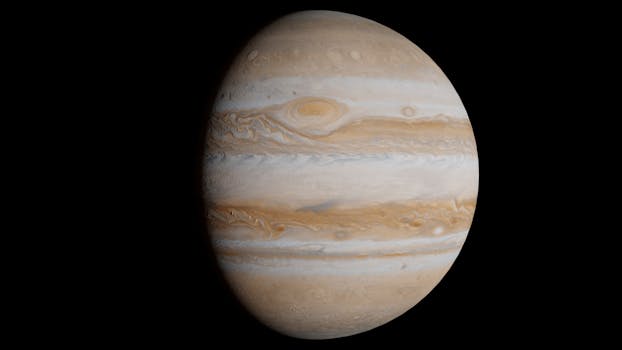
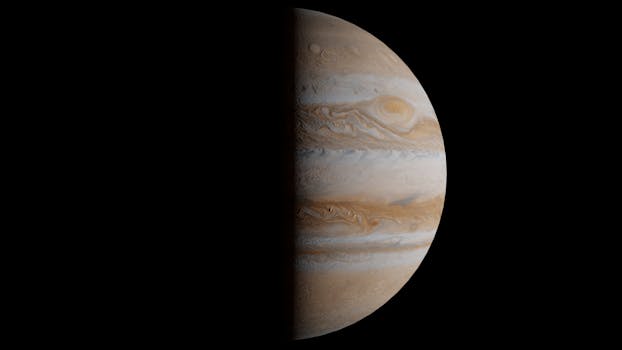
Jupiter's striking features include its enormous size—about 139,820 km in diameter—and its composition primarily of hydrogen and helium, similar to a star. The planet's surface is characterized by thick red, brown, yellow, and white clouds, creating a visually stunning, turbulent atmosphere. The Great Red Spot, a massive storm larger than Earth, is perhaps its most famous feature, showcasing the planet's dynamic and violent weather systems that can persist for centuries.
The Role of Space Missions in Unraveling Jupiter’s Mysteries
Historically, Jupiter has been a focus for numerous space missions that have greatly enhanced our understanding of the giant planet. The Pioneer and Voyager missions in the 1970s provided the first close-up images of Jupiter, revealing its complex ring system and many of its moons. More recently, NASA's Juno mission, which began orbiting Jupiter in 2016, has been instrumental in uncovering the secrets beneath its cloudy exterior, studying its auroras, and exploring its powerful magnetic field.
Comparing Mission Types: Flybys vs. Orbiters
Each type of space mission offers distinct advantages. Flyby missions, such as those conducted by the Voyager spacecraft, are cost-effective and can gather data from multiple planetary bodies along their trajectory. However, they offer only a fleeting glimpse of each planet. Orbiter missions, like Juno, provide a more comprehensive look at a single target. They can conduct detailed, long-term observations, which are crucial for understanding complex systems like Jupiter’s atmosphere and magnetosphere. The trade-off includes higher costs and the technological challenges of sustaining an orbit in harsh planetary environments.
Jupiter’s Impact on the Solar System
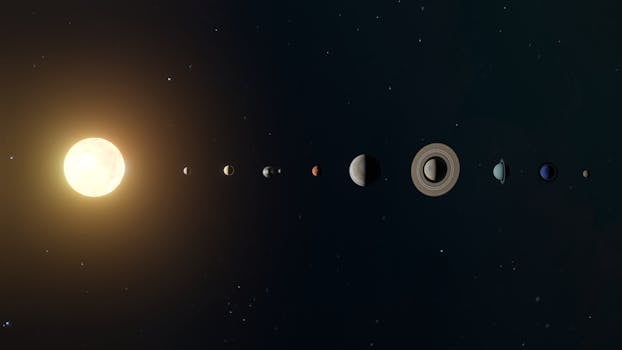
Jupiter's influence extends beyond its immediate vicinity. Its massive gravity impacts the orbital paths of other bodies in the solar system and contributes to the stability of the inner planets, including Earth. By deflecting comets and asteroids, Jupiter also plays a protective role, shielding the inner planets from potential impacts.
Conclusion: The Significance of Jupiter in Cosmic Exploration
The study of Jupiter is more than an academic pursuit; it provides essential clues to the processes that govern our solar system and others like it across the galaxy. Understanding Jupiter is crucial for models of planetary formation, the dynamics of weather on other planets, and even the potential habitability of other worlds in our solar system. As technology advances, future missions may reveal more about Jupiter’s moons, such as Europa and Ganymede, which are thought to have subsurface oceans that could harbor life. The exploration of Jupiter not only satisfies human curiosity but also expands our understanding of the universe.