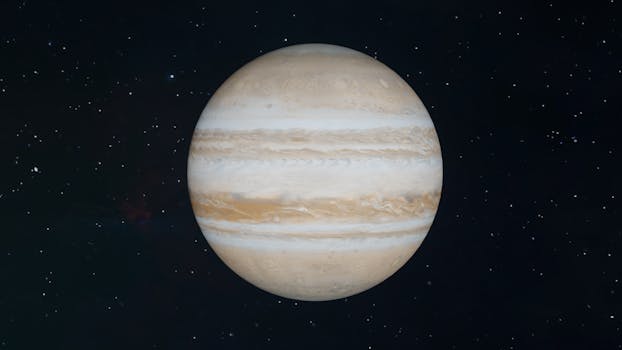
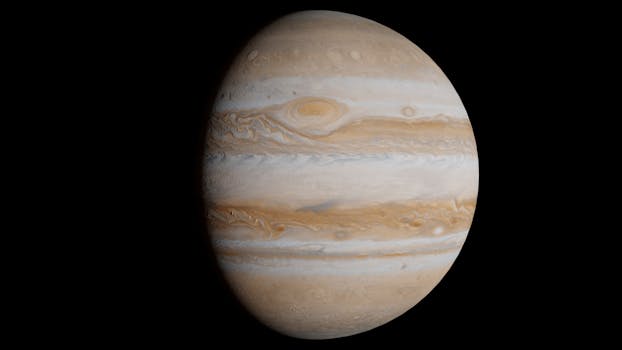
Jupiter's ring system, while not as visually stunning as Saturn's, presents a unique and intriguing aspect of our solar system's largest planet. Discovered in 1979 by NASA's Voyager 1 spacecraft, these rings challenged previous assumptions with their dusty composition and subtle visibility. This article delves into the mysteries of Jupiter's rings, exploring their composition, origin, and the dynamic processes that sustain them.
Composition and Structure
Jupiter's ring system consists of three main segments: the main ring, the halo, and the gossamer rings. Each has distinct characteristics:
.png)
- The Main Ring: This is the brightest and most prominent part of Jupiter's rings, primarily composed of dust particles with sizes similar to smoke particles, about a micrometer in diameter. These particles give the main ring a patchy appearance at high resolution.
- The Halo Ring: Encircling the inside of the main ring, the halo is a thick, donut-shaped cloud of dust. It is denser and more diffuse than the main ring.
- The Gossamer Rings: These are fainter and extend further out than the other rings. The Amalthea Gossamer Ring and Thebe Gossamer Ring are named after the moons they are associated with, suggesting a connection to their origin.
The particles forming these rings are darker, indicating a rocky composition, which contrasts sharply with the icy rings of Saturn. This difference in composition provides clues about the different environmental conditions and histories of these giant planets.
Origin and Maintenance
Jupiter's ring system is believed to be primarily sourced from its moons. Meteoroid impacts on moons such as Metis, Adrastea, Amalthea, and Thebe eject dust into Jupiter's orbit, replenishing the rings. This process, known as sputtering, is critical in maintaining the dusty rings of Jupiter.
Moreover, Jupiter’s immense gravitational pull plays a significant role in shaping the ring system. It keeps the particles in confined orbits and influences their distribution through gravitational resonances and perturbations.
Interaction with Jupiter’s Magnetic Field
An interesting aspect of Jupiter's rings is their interaction with the planet's strong magnetic field. The dust particles in the rings carry electrical charges and, therefore, react to the magnetic field. This interaction affects their motion and can cause particles to slowly spiral toward Jupiter, leading to the gradual erosion of the rings. Understanding these dynamics is crucial for scientists to predict the long-term stability and evolution of the ring system.
Scientific Importance and Ongoing Exploration
Studying Jupiter's rings offers valuable insights into the planet’s environment and helps to broaden our understanding of ring systems around other celestial bodies. Missions like NASA’s Juno spacecraft, which has been orbiting Jupiter since 2016, continue to provide crucial data that enhances our knowledge of how these rings form and evolve.
Conclusion
Though they may lack the visual splendor of Saturn's rings, the rings of Jupiter are a captivating subject of scientific study, offering a window into the complex and dynamic processes at play around the largest planet in our solar system. As space exploration advances, further studies of Jupiter's rings will likely reveal more about the nature of the planet and the fundamental processes that govern ring systems across the universe.