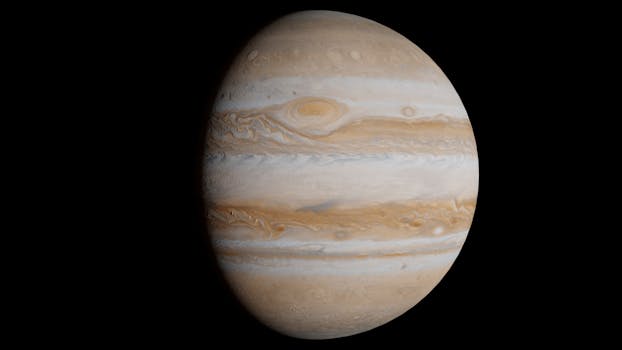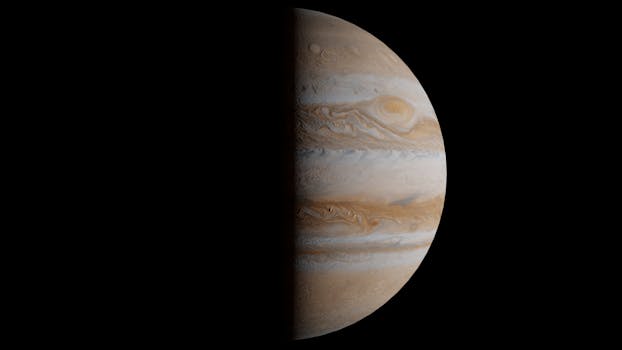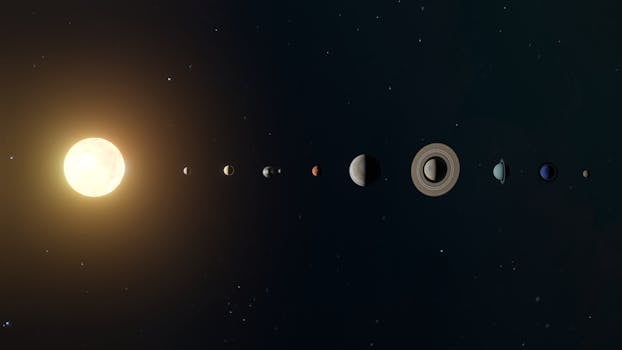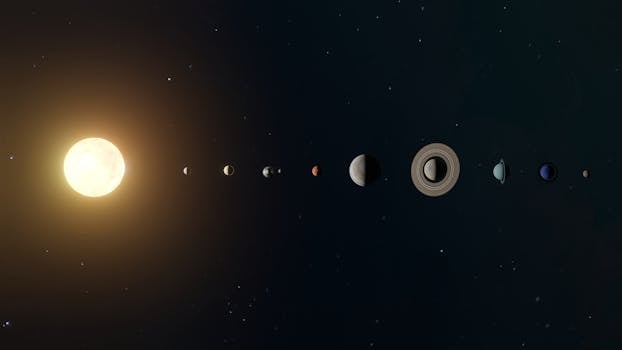
Jupiter, the behemoth of our solar system, exerts a significant influence on the cosmic neighborhood. As the largest planet, it not only dominates in size but also plays a pivotal role in maintaining the balance and safety of the solar system. This article delves into how Jupiter's gravitational force shapes the asteroid belt, protects the inner planets from extraterrestrial threats, and influences the orbits of surrounding celestial bodies.
Jupiter's Gravitational Force
Jupiter's gravitational pull is a major force within our solar system. This giant planet, with its substantial mass, orchestrates the movements of various bodies nearby. It is primarily responsible for maintaining the integrity of the asteroid belt, which lies between Mars and Jupiter. By exerting its gravitational force, Jupiter prevents these rocky fragments from merging into a new planet or veering off into the solar system, potentially colliding with other planets.
.png)
Cosmic Shield: Protection Against Comets and Asteroids
Perhaps one of Jupiter's most crucial functions is acting as a guardian to the inner planets, including Earth. Its strong gravitational field serves as a cosmic shield, deflecting or capturing comets and asteroids that could pose a threat. This protective mechanism has been instrumental in preserving the stability and safety of Earth, thereby playing a significant role in allowing life to flourish without the constant threat of extinction from space impacts.
Influence on Planetary Orbits
The impact of Jupiter extends beyond just acting as a protective barrier; it also significantly influences the orbits of other planets in the solar system. The gravitational pull of Jupiter can cause small but significant shifts in the orbits of nearby planets, which over time can affect their climate and overall habitability. In some theories, Jupiter's gravitational influence has been credited with stabilizing the orbit of Earth itself, reducing the amount of orbital eccentricity and thus making Earth a more stable and habitable environment.
Practical Examples of Jupiter's Influence
- The Trojans and the Greeks: Jupiter shares its orbit with two large groups of asteroids, known as the Trojans and the Greeks, which are held in place by Jupiter’s gravitational forces. These asteroids remain in stable Lagrange points, leading and trailing Jupiter in its path around the Sun.
- The Late Heavy Bombardment: During this period, which occurred approximately 4 billion years ago, the inner solar system experienced a heavy barrage of asteroid impacts. Jupiter may have played a direct role by perturbing the orbits of cometary bodies in the outer solar system, directing some of these towards the inner planets.
Conclusion
Jupiter's multifaceted role in the solar system extends from a gravitational anchor and protector to a stabilizer of planetary orbits. Its presence and position have likely been key factors in the development and sustainability of life on Earth by minimizing the impact of potentially catastrophic celestial collisions. As exploration and understanding of our solar system continue to evolve, the study of Jupiter’s powerful influence remains essential for comprehending our place in the cosmos. This giant planet does more than just orbit the Sun; it actively shapes the dynamic space environment of our solar system, fostering conditions conducive to life on Earth.